Let’s start with something nobody tells you.
Before the rockets. Before the electric cars. Before the billions, the headlines, the Twitter drama, and the Mars obsession — there was a skinny, socially awkward kid sitting alone in a school library in Pretoria, South Africa, reading encyclopedias for fun because he had already finished every book in the house.
That kid got thrown down a flight of stairs by a gang of classmates and beaten so badly he couldn’t breathe. He required surgery. He cried alone because he had no one to call a real friend.
That kid is Elon Musk.
And that version of his story — the one before the legend — is the one worth knowing. Not because it makes him more likeable, or because it’s meant to inspire you in some neat, packaged way. But because it’s true. And the truth of where someone begins tells you everything about how they became who they are.
So forget the headlines for a moment. Forget the controversies, the politics, the memes. Go back to the beginning — to a dusty city in South Africa in the 1970s, to a quiet boy with an extraordinary mind and no idea what to do with it.
This is where the real Elon Musk story starts.
The Boy Nobody Wanted to Sit With
(cite index=”10-1″>Elon Reeve Musk was born on June 28, 1971, in Pretoria, South Africa. His mother, Maye Musk, is a Canadian model who at one point worked five jobs to support her family. His father, Errol Musk, is a wealthy South African engineer.</cite)
On paper, it sounds fine. Two parents, a comfortable enough home, a stable neighbourhood. But the inside of that childhood was considerably messier than the outside.
His parents divorced when he was ten. That kind of thing can cut a sensitive kid in half — and Elon was about as sensitive as they came. He processed everything internally. He felt things deeply. He just didn’t know how to explain any of it to other people, because connecting with other people was genuinely, profoundly difficult for him.
(cite index=”16-1″>He struggled to understand social cues because of his Asperger’s Syndrome.</cite) Years later, Musk would publicly acknowledge his diagnosis on Saturday Night Live, almost casually, as if it were just a biographical footnote. But as a child in South Africa in the early 1980s, there was no diagnosis, no label, no framework to understand why he couldn’t quite read the room the way everyone else seemed to. He was just the weird kid. The one who stared too long and talked too intensely about things nobody else cared about.
(cite index=”14-1″>From an early age, he was different. While other kids played outside, Elon buried himself in books, teaching himself programming from a manual.</cite) He once said, and this line has stuck with me: “I was raised by books — books, and then my parents.”
Think about that for a second. Not sports. Not friends. Not television. Books.
He wasn’t performing. He genuinely preferred the company of ideas to the company of people who didn’t understand him. That’s not a romantic version of loneliness — that’s just what loneliness actually looks like when someone is trying to make the best of it.
The Staircase
Here is the moment that most biographies gloss over or mention in a single polite sentence.
(cite index=”14-1″>He was often bullied for being quiet, nerdy, and awkward. Once, a group of boys pushed him down a staircase and beat him so badly that he couldn’t breathe. He had to undergo surgery.</cite)
Let that sit for a moment.
This wasn’t a shove in a hallway. This wasn’t name-calling. A group of kids beat a child so severely that he required medical intervention. (cite index=”15-1″>Elon was once thrown down a flight of stairs by a gang of classmates and kicked into a bloody mess.</cite)
And the worst part? The ringleader of that group — the boy who led the attack — Musk would later describe encountering again as adults. By then the former bully was barely recognisable, life having worn him down in the ordinary ways it wears people down. Musk felt no particular satisfaction about this. He mentioned it the way you mention something that happened to someone you used to know.
(cite index=”15-1″>After the attack, Elon trained in judo, karate, taekwondo, and Brazilian jiu-jitsu to be able to better protect himself and his brother Kimbal.</cite) And then something shifted. (cite index=”10-1″>By the time he was 15, he went through a growth spurt and the bullying stopped.</cite)
But here’s the thing — and this matters for understanding everything that came after: Musk didn’t become harder from that experience. He didn’t build walls. He redirected. He went deeper into the one place where no one could follow him and hurt him — the world of ideas, of code, of physics, of science fiction that felt more real to him than the actual present.
He escaped into the future.
Twelve Years Old. Five Hundred Dollars. And a Video Game Called Blastar.
(cite index=”11-1″>At just 12 years old, he coded a video game called Blastar and sold it to a computer magazine for $500.</cite)
Five hundred dollars doesn’t sound like much. It isn’t much. But think about what it represented for a twelve-year-old boy in South Africa in 1983, sitting alone in his room, teaching himself to code from a manual he’d read cover to cover.
It was proof.
Not proof to anyone else — nobody particularly cared about a kid selling a game to a magazine. It was proof to him. Proof that the thing he was doing in his room, alone, the thing that made him strange and separate from everyone around him — that thing had value. That ideas, encoded into something real, could be exchanged for something tangible in the world.
That lesson — that the contents of your mind can be turned into something of measurable worth — is arguably the most important thing Elon Musk ever learned. And he learned it at twelve, from a video game about shooting enemy spaceships.
(cite index=”15-1″>Elon’s father Errol sent him and his brother Kimbal to a wilderness survival camp known as a “veldskool” when Elon was 12. In the camp, the children were given small portions of food and water and were encouraged to fight over their meagre provisions. The bigger and older kids took advantage of the Musks.</cite)
So at twelve, he was simultaneously selling his first commercial product and being sent to a camp where older children took his food. The contrast is almost impossible to hold in a single image — and yet it’s exactly the kind of contradiction that forged whatever it is he became.
Getting Out
(cite index=”18-1″>He was deeply dissatisfied with South Africa’s apartheid regime, and he refused to participate in it. His desire was to reach America, the land of freedom and opportunity. To do so, Elon used his connections to Canada via his mother.</cite)
At seventeen, Elon Musk left South Africa with almost nothing.
(cite index=”12-1″>He moved to Canada, working various odd jobs — including cleaning boilers — before finally making his way to the United States.</cite) Think about that transition for a moment: from a relatively comfortable family home in Pretoria to cleaning industrial boilers in Canada. That’s not a metaphor. That was Tuesday.
He also worked on farms. He shovelled grain. He did whatever paid, whatever kept him moving, whatever got him closer to the place he needed to be.
(cite index=”14-1″>At 17, Elon left South Africa to avoid military service and seek better opportunities. He graduated with degrees in Physics and Economics, but had something bigger in mind than a 9-to-5 job. He believed the internet, space exploration, and renewable energy were the keys to humanity’s future — and he was determined to be a part of all three.</cite)
Three things. Internet, space, energy. He identified them as a teenager.
Not one thing — three. And not just as interesting fields to work in. As the defining challenges of the human future. When you are seventeen years old and you have already mapped out the three areas where you intend to spend your life, something is happening inside you that most people will never fully understand.
He studied at Queen’s University in Ontario before transferring to the University of Pennsylvania — an Ivy League institution — where he earned degrees in both physics and economics. Not one degree. Two. Because apparently one was not enough to contain what he needed to know.
Two Days at Stanford. Then Everything Changed.
In 1995, Elon Musk was accepted to the PhD programme at Stanford University to study energy physics. It was the kind of acceptance that families frame and hang on walls. The kind that means you have made it.
He lasted two days.
(cite index=”12-1″>After just two days of grad school at Stanford, Musk dropped out. The internet was exploding, and he didn’t want to miss the wave.</cite)
This decision gets romanticised a lot. People tell it as a heroic story — the visionary who abandoned the academic path to chase his destiny. And maybe it was. But it’s worth pausing to appreciate how genuinely terrifying that must have been. You have spent years working toward this. You have crossed oceans and cleaned boilers and studied physics and economics simultaneously to get here. And then you walk away from it in forty-eight hours because you feel, in your gut, that something else is happening and you need to be in the middle of it.
That is not a comfortable feeling. That is the feeling of standing at the edge of something with no safety net and jumping anyway.
He jumped.
The Office Floor, the YMCA Shower, and Zip2
(cite index=”11-1″>In 1995, Elon and his brother Kimbal started a company called Zip2. Their goal was to provide online business directories and maps for newspapers — a kind of early version of Google Maps meets Yelp. At the time, most people didn’t even understand the internet.</cite)
Here is where the story gets both unglamorous and important.
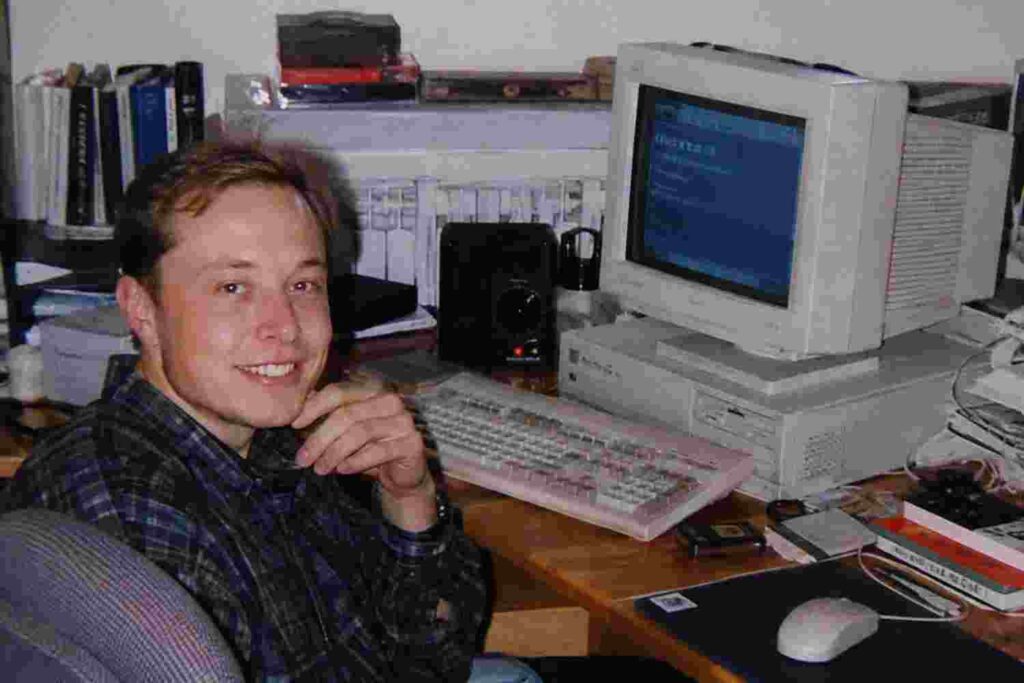
(cite index=”12-1″>The two of them lived in a tiny office, sleeping on a couch and showering at the local YMCA. At one point, they couldn’t even afford an apartment.</cite)
This is the part that gets left out of the inspirational posters. The guy who would one day be worth hundreds of billions of dollars was showering at the YMCA because he and his brother could not afford rent. They ate cheap food. They worked absurd hours. Elon coded through the night, slept briefly, and then coded again.
(cite index=”14-1″>Elon coded the entire platform himself, sleeping on a beanbag in the office and showering at the local YMCA.</cite)
What kept him going? It wasn’t confidence that it would work — he couldn’t have known that. It wasn’t a safety net — there wasn’t one. It was something closer to the conviction that this was where he was supposed to be, doing exactly this, regardless of how uncomfortable the present moment was.
The newspapers were slow to adopt the internet. Investors were skeptical. The product needed constant iteration. There were moments — many of them — where quitting would have been the rational choice.
He didn’t quit.
(cite index=”11-1″>After a few tough years, Zip2 started gaining traction. In 1999, Compaq bought Zip2 for $307 million, and Musk personally walked away with $22 million.</cite)
Twenty-two million dollars. At twenty-seven years old. After years of sleeping on a beanbag and showering at the YMCA.
Most people, at this point in the story, retire. Or at least slow down. Buy a house. Take a holiday. Breathe.
He Did Not Breathe.
(cite index=”11-1″>Instead of retiring young, he reinvested his fortune into X.com, which later became PayPal.</cite)
(cite index=”16-1″>X.com later became PayPal, which specialised in transferring money online and revolutionised online transactions.</cite)
(cite index=”16-1″>”My proceeds from PayPal after tax was about $180 million. $100 million of that went into SpaceX, $70 million into Tesla, and $10 million into SolarCity. And I had to borrow money for rent.” — Elon Musk, 2018 interview.</cite)
Read that again.
He took every dollar he made from PayPal — one hundred and eighty million dollars — and put it into his next ventures. All of it. And then he borrowed money to pay his own rent.
This is the moment that separates Elon Musk from almost every other wealthy person in history. Not the fact that he made money. Plenty of people make money. It’s the fact that he took money he had already earned — money that represented years of beanbag sleeping and boiler cleaning and YMCA showers — and bet every dollar of it on the things he believed were worth building.
That is not genius. That is not strategy. That is something closer to faith.
What the Early Life Actually Tells Us
You could read this story as an inspirational arc — bullied kid becomes billionaire, adversity builds character, etc. — and it wouldn’t be wrong, exactly. But it would be incomplete.
What the early life of Elon Musk actually reveals is something stranger and more interesting than a motivational poster.
It reveals a person who was, from the very beginning, operating on a completely different timeline than everyone around him. While other kids were learning to socialise, he was reading encyclopaedias. While other teenagers were figuring out what they wanted to do with their lives, he had already identified three civilisation-scale problems he intended to solve. While his peers at Stanford were settling in for five years of graduate study, he was walking out the door after two days because he could feel the future moving and he wasn’t in it yet.
The bullying, the isolation, the divorce, the YMCA showers — these things didn’t make him who he is. But they are the terrain through which who he already was had to pass. And passing through that terrain, without breaking, without giving up, without letting the difficulty of the present convince him that the future he could see was not real — that is the part of the story that matters.
The rockets and the electric cars get all the attention. They deserve attention — they are genuinely extraordinary achievements.
But the real story — the one that explains how those things became possible — starts in a library in Pretoria, with a skinny kid reading every book he could find, building a life inside his own mind because the one outside it wasn’t ready for him yet.
And then, when the world finally was ready — he was already there waiting.
Frequently Asked Questions (FAQ)
Q1: Where was Elon Musk born and what was his childhood like? (cite index=”10-1″>Elon Reeve Musk was born on June 28, 1971, in Pretoria, South Africa. He spent his early childhood with his brother Kimbal and sister Tosca. His parents divorced when he was 10.</cite) His childhood was difficult — marked by social isolation, bullying severe enough to require hospitalization, and the internal displacement of a child who felt fundamentally out of step with the world around him. He found refuge in books and computers, teaching himself programming from manuals and creating his first commercial product — a video game called Blastar — at age twelve.
Q2: What was Elon Musk’s first business before Tesla and SpaceX? (cite index=”11-1″>In 1995, Elon and his brother Kimbal started a company called Zip2. Their goal was to provide online business directories and maps for newspapers. After a few tough years, Zip2 was sold to Compaq in 1999 for $307 million, and Musk personally walked away with $22 million.</cite) His second venture — X.com — eventually became PayPal, which was acquired by eBay. His PayPal proceeds funded the founding of both SpaceX and Tesla simultaneously.
Q3: Why did Elon Musk leave South Africa? (cite index=”18-1″>He was deeply dissatisfied with South Africa’s apartheid regime and refused to participate in compulsory military service. His desire was to reach America, the land of freedom and opportunity.</cite) He left at seventeen, initially emigrating to Canada through his mother’s citizenship connections, before eventually making his way to the United States through the University of Pennsylvania.
Q4: Is it true that Elon Musk dropped out of Stanford after two days? Yes — and it’s one of the most consequential decisions in technology history. (cite index=”12-1″>After just two days of grad school at Stanford, Musk dropped out. The internet was exploding, and he didn’t want to miss the wave.</cite) He had been accepted to study energy physics at the PhD level. Instead, he co-founded Zip2 with his brother Kimbal, beginning the entrepreneurial journey that would eventually lead to Tesla, SpaceX, and everything that followed.
Q5: How did Elon Musk fund Tesla and SpaceX? Entirely from his own earnings — and at enormous personal financial risk. (cite index=”16-1″>”My proceeds from PayPal after tax was about $180 million. $100 million of that went into SpaceX, $70 million into Tesla, and $10 million into SolarCity. And I had to borrow money for rent.” — Elon Musk, 2018 interview.</cite) He invested every dollar of his PayPal proceeds into his next ventures, leaving himself with nothing liquid — reportedly borrowing money from friends to cover basic living expenses while simultaneously funding two of the most ambitious companies in the history of private enterprise.
Article published on Factsnest.com | Category: Biographies & Extraordinary Lives Sources: Biography.com; Vocal Media; Education Next; Servant Financial; Hot History Substack; Scribd entrepreneurial journey archive. All biographical facts verified against Walter Isaacson’s authorized biography “Elon Musk” (2023) and multiple independent sources.