
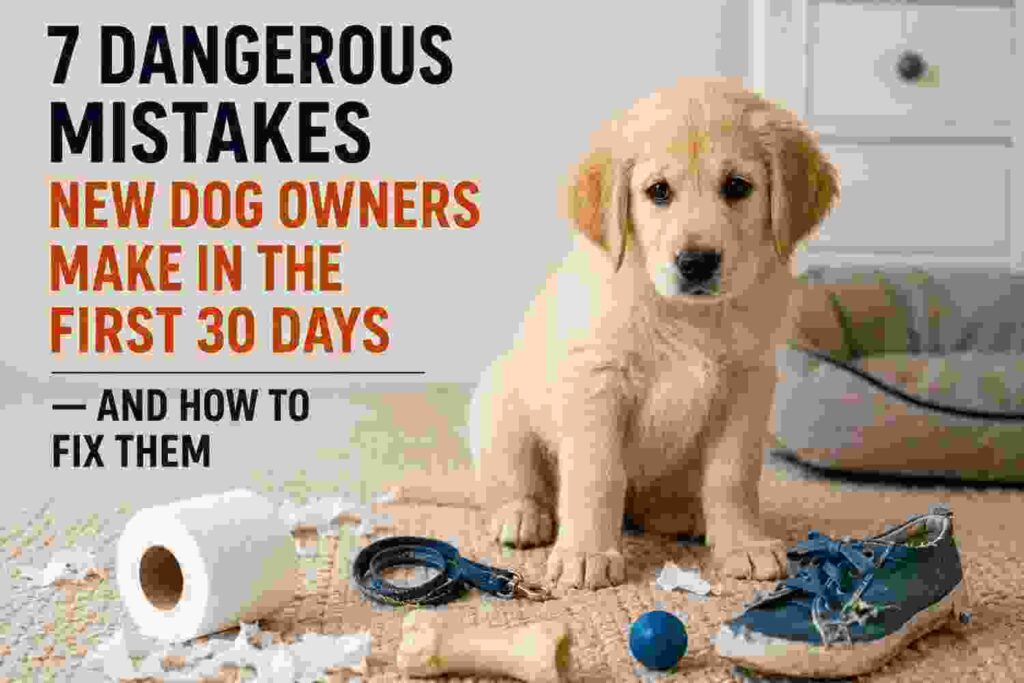
Nobody tells you how hard the first 30 days actually are.
You bring this creature home — this soft, wide-eyed, slightly terrified animal — and you are so full of love and excitement that you miss something important. That dog is not excited right now. That dog is overwhelmed. Everything it has ever known — its littermates, its familiar smells, the sounds and rhythms of where it came from — disappeared in one car journey.
And what it finds on the other side is you. Well-meaning, eager, absolutely clueless about what it actually needs.
That’s not an insult. That’s just the truth of how most of us begin.
(cite index=”20-1″>The truth is, most new puppy owner mistakes happen not from carelessness but from simply not knowing what the first 30 days actually require.</cite) And here is the part that matters — (cite index=”20-1″>puppies trained gently in the first month using positive reinforcement retain those lessons far more reliably than dogs trained later.</cite) The first 30 days are not a warm-up period. They are the foundation. Everything you build after this rests on what happens right now.
So let’s talk about the seven mistakes that most new dog owners make — the ones with real consequences — and more importantly, exactly how to fix them.
Mistake #1: Overwhelming Your Dog With People, Noise, and Excitement on Day One
The moment you pull into the driveway with your new dog, the instinct is to share the joy. Call the family in. Let the kids meet it. Invite the neighbours over. Post on Instagram. Let the chaos begin.
Please don’t.
(cite index=”21-1″>One of the first things everyone wants to do is introduce their new puppy to family and friends. But if there’s one piece of advice worth giving every family, it would be to keep those first few days as calm as possible.</cite)
Think about it from the dog’s perspective. It has just been removed from every familiar thing it has ever known. Now it is in a strange house, surrounded by strange smells, and a crowd of strangers is rushing toward it making high-pitched noises and reaching their hands out.
That is not a welcome party. That is a threat.
(cite index=”21-1″>Some dogs walk into a new house like they’ve lived there forever, while others need a little more reassurance before they feel comfortable.</cite) You cannot know which kind you have on day one. So treat every dog as if it needs the reassurance. Give it a quiet room. Let it sniff at its own pace. Sit on the floor near it — not over it — and let it come to you.
The fix: For the first 48–72 hours, limit your dog’s world to one or two rooms and a small number of people. Turn the volume down — literally and figuratively. Let the dog set the pace for every new introduction. The excitement can come later. The trust must come first.
Mistake #2: Skipping the Crate — Or Using It as Punishment
Half of new dog owners resist the crate because it looks like a cage and feels cruel. The other half use it as a consequence — “bad dog, go to your crate.” Both approaches will cause you significant problems.
(cite index=”14-1″>Dog crates are an essential tool for training puppies. A common mistake is confining your dog to the kennel without first giving them an opportunity to acclimate.</cite)
Here is the reframe that changes everything: a crate is not a punishment. It is a den. Dogs are den animals by nature — they seek enclosed, safe spaces when they are stressed, tired, or overwhelmed. When introduced correctly, most dogs actively choose their crate as their place of rest. It becomes their room. Their sanctuary. The place they go when the world is too much.
The problems start when owners either skip the crate entirely (leading to destructive behaviour, separation anxiety, and housetraining nightmares) or use it as a consequence (teaching the dog that the crate means trouble, which makes it resist going in — the exact opposite of what you need).
(cite index=”14-1″>Once your dog is adjusted to their new kennel, leave your pup there for a maximum of four hours at a time if possible.</cite) Never longer than that during the day. And never as a reaction to bad behaviour.
The fix: Introduce the crate on day one, before you need it. Feed meals inside it with the door open. Toss treats in. Put a worn piece of your clothing inside so it smells like you. Build a positive association first — then gradually close the door for short periods. By the end of week two, most dogs will walk into their crate voluntarily. That is the goal.
Mistake #3: Ignoring the Socialisation Window — The Mistake You Cannot Undo
This is the one that breaks my heart most, because by the time owners realise they’ve made it, it is often too late to fully fix.
(cite index=”22-1″>The American Veterinary Society of Animal Behavior (AVSAB) identifies the first three months of a puppy’s life as the primary and most important socialisation period.</cite) This window — roughly 3 to 12–14 weeks — is when a puppy’s brain is specifically wired to learn what is safe and what is not. Experiences during this period leave lasting neurological impressions.
(cite index=”22-1″>Socialisation does not mean forcing a frightened puppy to interact.</cite) That distinction is critical and widely misunderstood. Dragging a terrified puppy into a dog park and calling it socialisation is not socialisation — it is trauma. What socialisation actually means is calm, positive exposure to the things that puppy will encounter throughout its life: different people, different surfaces, different sounds, other animals, traffic, children, umbrellas, men with beards, wheelchairs, bicycles.
New owners delay this because they are waiting for the puppy to be fully vaccinated. The veterinary community has shifted significantly on this — (cite index=”22-1″>the risk of a poorly socialised dog developing behaviour problems is considered greater than the risk of disease when exposure is managed carefully.</cite) Puppy classes with vaccinated dogs, carries in your arms through busy environments, gentle home visits — these are ways to socialise before the vaccination schedule is complete.
The fix: Start socialisation immediately. Aim for as many positive, calm exposures to new things as possible before 14 weeks. Keep each experience brief and positive — the dog should be curious or calm, not terrified. If it is terrified, you have gone too far too fast. Back up and try again at a greater distance or with less intensity.
Mistake #4: Letting Bad Behaviour Slide Because “It’s Just a Puppy”
A puppy jumping up on you is adorable. That same dog at 65 kilograms knocking your elderly mother to the ground is a crisis. The behaviour did not change. The dog just got bigger.
This is the “it’s just a puppy” trap — and it catches more new owners than almost any other mistake on this list.
(cite index=”14-1″>Puppies don’t know the rules unless we teach them. Without structured enrichment and clear guidance, puppies will seek their own outlets.</cite)
Every single time you allow a behaviour you do not want long-term, you are teaching the dog that the behaviour is acceptable. The dog is not being naughty. The dog is doing exactly what it has learned works. If jumping up gets attention — even the negative attention of being pushed away and told “no” — jumping up works. Dogs repeat what works.
The moment you bring the dog home, you are training it. Even when you think you are not. Especially when you think you are not.
The fix: Decide before the dog comes home what behaviours you will and will not allow as an adult dog. No sofa? Then never allow it on the sofa — not even once as a puppy because it is cute. Jumping? Never reward it with attention. Turn your back. Wait for four paws on the floor. Reward that immediately. The rule is simple: the behaviour you reward is the behaviour you get more of.
Mistake #5: Over-Exercising a Puppy — Yes, Really
This one surprises people. They know they need to exercise the dog. They take it for a long walk every morning. They are doing the right thing, surely?
Not necessarily.
(cite index=”20-1″>Most puppies require 16 to 18 hours of sleep per day. Owners who keep puppies constantly engaged, stimulated, or socialising can trigger overtiredness, which in puppies looks a lot like hyperactivity, biting, and difficulty settling.</cite)
There is a well-known guideline in puppy development: five minutes of exercise per month of age, twice daily. A 3-month-old puppy needs approximately 15 minutes of exercise twice a day. That’s it. Not an hour. Not a 5km run.
(cite index=”14-1″>One 20- to 30-minute training lesson can wear out a puppy and interfere with their ability to focus.</cite)
The reason over-exercise matters goes beyond tiredness. Puppies’ growth plates — the soft areas of developing bone — are not fully closed until 12–18 months depending on breed size. Sustained, high-impact exercise on developing joints can cause damage that shows up years later as arthritis, hip dysplasia, or chronic pain. You will not see the consequences immediately. But they come.
(cite index=”20-1″>Rest is not optional — overtiredness in puppies looks a lot like hyperactivity, biting, and difficulty settling.</cite) If your puppy is a biting, bouncing chaos machine in the evenings, the answer is almost never more exercise. It is more sleep.
The fix: Follow the five-minutes-per-month-of-age rule strictly for walks on hard surfaces. Supplement with short, low-impact play sessions, training games of 5–10 minutes, and enforced nap times in the crate. A well-rested puppy is a trainable puppy. A chronically overtired puppy is the one that bites your ankle every single evening.
Mistake #6: Feeding the Wrong Food — Or the Wrong Amount
(cite index=”22-1″>If you have an adult dog at home, be wary of feeding the same food to your new puppy. Puppies have high protein and fat needs compared to adult dogs, so they’ll thrive better on a diet designed just for them.</cite)
Walk into any pet shop and the choice is overwhelming. Every bag claims to be premium, natural, complete, and superior. Most new owners either grab whatever is cheapest, continue whatever the breeder or shelter was feeding, or switch to something “better” immediately.
Of these, only the second approach is right — and only for a specific reason. Switching food abruptly causes digestive upset: loose stools, vomiting, discomfort. (cite index=”15-1″>During the first 30 days especially, keep your puppy on their designated puppy food and avoid table scraps entirely.</cite) If you want to change the food, transition over 7–10 days by gradually mixing the new food in with the old.
The other critical feeding mistake is quantity. (cite index=”22-1″>Active puppies that are getting the food intake they need will be neither overweight nor underweight.</cite) Overfeeding a puppy — especially a large breed — is not kindness. Rapid growth in large breeds is directly linked to joint problems in adulthood. Feed to the guidelines on the packaging, adjusted by your vet’s assessment of your dog’s body condition.
The fix: For the first two weeks, feed exactly what the breeder or shelter was feeding — same food, same schedule. After that, if you want to change, do it gradually over 10 days. Feed puppy-specific food for the first 12 months (or longer for large breeds). Measure portions. Weigh your dog monthly. And unless your vet specifically recommends it, put down the table scraps.
Mistake #7: Waiting Too Long to See a Vet
(cite index=”16-1″>The first few days with a new pet are a strange mix of joy and panic. Pets cost more than the adoption fee, and surprise vet bills are one of the biggest sources of stress for new owners.</cite)
Because of this, many new owners delay the first vet visit. The dog seems fine. No obvious illness. Why spend the money right now?
Here is why.
The first vet visit is not primarily about treating illness. It is about establishing a baseline — knowing what your specific dog’s normal looks like, so that when something changes, you have something to compare it to. It is about starting the vaccination schedule that protects against diseases that kill puppies quickly. It is about getting professional eyes on your dog’s weight, dental development, heart, and overall physical condition.
(cite index=”16-1″>Call your vet if you see: not eating or drinking for a day or more (sooner for puppies, kittens, and small pets).</cite) Puppies deteriorate fast. A puppy that is off its food for 24 hours can become critically ill within another 24. The signs that would be a mild concern in an adult dog are emergencies in a very young animal.
The fix: Book the vet appointment before the dog comes home. Within the first 48–72 hours, have your new dog examined — even if it appears perfectly healthy. Establish the relationship with the practice, get the vaccination schedule confirmed, ask about parasite prevention, and ask every question you have been too embarrassed to Google. A good vet will never judge you for asking too much. They will only be concerned if you are not asking at all.
The Bigger Picture: What the First 30 Days Are Actually For
Step back from the individual mistakes for a moment.
The first 30 days are not about training your dog to do tricks. They are not about getting it to sleep through the night, or stop biting, or walk nicely on a lead — although all of these things benefit from what happens in this period.
The first 30 days are about one thing: building trust.
Your dog needs to learn that you are safe. That this new place is safe. That the routine is predictable. That when something is confusing or scary, you will not make it worse.
(cite index=”21-1″>Every successful potty break, every quiet nap, and every positive interaction helps them start to understand what life looks like with their new family.</cite)
The families who get through the first month without crisis are not the ones who bought the most equipment or read the most training books. (cite index=”21-1″>They are the ones who understand that bringing home a puppy is a huge adjustment — and that the dog needs as much support through that adjustment as you do.</cite)
Calm beats excited. Consistent beats intense. Patient beats perfect.
You will make mistakes. Every single dog owner does, including the ones who have been doing this for decades. The goal is not a flawless first 30 days. The goal is a dog who, at the end of those 30 days, looks at you and sees someone it can trust.
That is the foundation. Build it right, and everything else follows.