
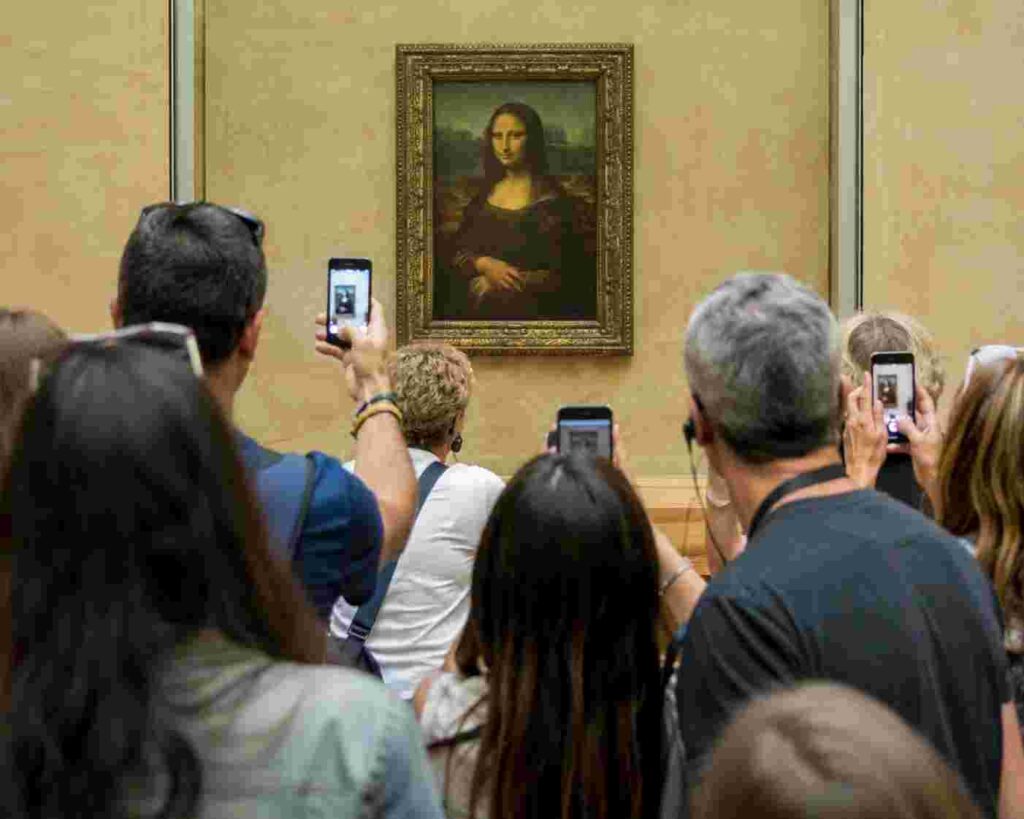
Every year, eight million people shuffle through the Louvre in Paris, push past each other with their phones held high, and squint across a rope barrier at a painting roughly the size of a piece of carry-on luggage.
They have waited months to be here. Some have flown across the world. And when they finally see it — this small, brownish portrait of a woman with a faint smile — the overwhelming reaction is some version of the same thing.
That’s it?
(cite index=”31-1″>It is the most famous painting in the world, and yet, when viewers manage to see the artwork up close, they are likely to be baffled by the small, subdued portrait of an ordinary woman.</cite)
The disappointment is so consistent, so universal, that it has become a cultural phenomenon in its own right. There is even a name for it — Paris Syndrome — the psychological shock tourists experience when the city, or the art, fails to match the impossible expectation built up around it.
But here is the question nobody standing in that queue seems to ask: why is the Mona Lisa famous in the first place?
Because the answer — the real answer — has almost nothing to do with Leonardo da Vinci, and almost nothing to do with the painting itself. It has everything to do with a Monday morning in August 1911, a former handyman with a grudge, and the most consequential art theft in human history.
This is the story they do not tell you at the Louvre.
Before 1911, Almost Nobody Cared About It
Let’s start with the fact that will rearrange everything else.
(cite index=”29-1″>Before 1911, the Mona Lisa was only really popular in some artist circles. From the creation of the painting until the 1800s it was very unknown. Some in the art world were familiar with the work, but the average person would never have heard of it.</cite)
Think about that. For almost four centuries after Leonardo da Vinci completed the painting — somewhere around 1503 — it sat in relative obscurity. It was admired within certain circles of connoisseurs and artists. It was housed in the Louvre from the time Napoleon had it moved to his bedroom (genuinely), and eventually placed in a gallery. But it was not the Mona Lisa. Not yet.
(cite index=”33-1″>At the time of the theft in 1911, the Mona Lisa was far from the most visited item in the museum.</cite)
People walked past it. They looked at other things. The Louvre was full of paintings more famous, more dramatic, more immediately impressive in scale and color. Nobody was crossing oceans to look at a small, darkened portrait of a Florentine merchant’s wife.
(cite index=”31-1″>The writers of the 19th century aroused some interest in the Mona Lisa, but it was the theft of the painting in 1911 and the ensuing media frenzy that brought it worldwide attention.</cite)
Then came Vincenzo Peruggia.
The Man Who Accidentally Made History
On the evening of Sunday, August 20, 1911, a short, mustachioed man entered the Louvre and found a closet to hide in.
He waited there through the night.
(cite index=”27-1″>On a quiet, humid Monday morning in Paris, August 21, 1911, with the museum still closed to visitors, Vincenzo Peruggia emerged from hiding, walked to the Salon Carré, and seized the Mona Lisa off the wall. A few moments later, he walked out of the Louvre with one of the world’s most valuable paintings tucked beneath his apron.</cite)
Peruggia was not a mastermind. He was not executing a sophisticated heist on behalf of a shadowy collector. He was a 29-year-old former handyman who had once worked at the Louvre helping to install the glass cases that protected its paintings — including the glass case that protected the Mona Lisa.
He chose the Mona Lisa for a reason that is almost comical given what followed: (cite index=”28-1″>he chose this piece not because it was particularly famous — because at this point it wasn’t — but because it was small, measuring 77 centimeters high and 53 centimeters wide. Small enough to carry.</cite)
(cite index=”26-1″>Peruggia claims he was motivated to steal the painting to return it to Italy’s rightful hands. He was upset by the idea that Napoleon had stolen it — despite the historical fact that da Vinci himself had gifted the painting to France when he moved there in the 16th century.</cite)
He was wrong about Napoleon. He was wrong about the history. But none of that mattered. He tucked the painting under his apron, walked through a service door, and disappeared into Paris.
(cite index=”27-1″>For more than a day, the Louvre’s staff had no clue that the Mona Lisa had been stolen.</cite)
The Empty Wall That Changed Everything
Here is where the story turns genuinely strange.
When the Louvre finally realized the painting was gone, it closed for a week. And when it reopened? (cite index=”28-1″>More people came to see the empty space where the Mona Lisa used to hang than had visited the painting the previous year.</cite)
Read that again. People queued to look at a blank wall. A rectangle of slightly less-faded paint where a picture used to be. They came in greater numbers than had ever come to see the actual painting.
(cite index=”26-1″>The Mona Lisa was on the front page of every newspaper and the topic of countless articles. The sensational theft captivated the world, sparking widespread speculation and intense public interest.</cite)
This was 1911. There was no internet, no social media, no 24-hour news cycle. And yet the theft of this painting — a painting that most people had never heard of and never thought to look at — became one of the biggest news stories in the world. Newspapers ran it as their lead story for weeks. (cite index=”24-1″>Police circulated wanted posters of the Mona Lisa’s enigmatic half-smile.</cite) The image of the painting was suddenly everywhere, reproduced in publications across Europe and America.
And crucially — everyone who saw those reproductions now had a face in their memory. A specific image. The woman with the smile. The painting that someone wanted badly enough to steal.
(cite index=”26-1″>As soon as the painting was stolen in 1911, conspiracy theories sprouted up. A few months before the painting was found, the New York Times speculated that Louvre restorers had botched a restoration job of the Mona Lisa; to cover this up, the museum concocted the story of an outlandish theft.</cite)
Even the conspiracy theories made her more famous.
Picasso Was a Suspect. Yes, Really.
This detail is too good to leave out.
In the chaos following the theft, the Paris police were desperate. They needed suspects. And in the art world of 1911 Paris, suspicion fell on some unexpected names — including, briefly, Pablo Picasso.
(cite index=”25-1″>Thinking they had found their way into a crime ring that might be behind the Mona Lisa case, the cops dragged Picasso before a magistrate for questioning. But prosecutors couldn’t build a case that either Picasso or his friend Apollinaire had stolen the painting, and both of them went free.</cite)
Picasso had nothing to do with it. But the fact that the investigation swept up the most famous living artist in the world only added another layer of drama to an already extraordinary story.
Two Years in a Trunk
Meanwhile, Vincenzo Peruggia was living in a one-room apartment on the outskirts of Paris with the most famous painting in the world hidden in a wooden trunk with a false bottom.
(cite index=”27-1″>Unbeknownst to police, the Mona Lisa had never left France. From the very day it was stolen, it had languished in a one-room apartment on the outskirts of Paris. Peruggia kept the Mona Lisa hidden for two years while he waited for the heat to die down.</cite)
He had planned to sell it. But the problem was that the Mona Lisa had, in the two years since the theft, become globally recognizable. (cite index=”29-1″>He had stolen the Mona Lisa in order to sell it but it was quickly becoming internationally known and was too hot for the black market, too recognizable.</cite)
He had created his own problem. The theft had made the painting so famous that he could no longer safely move it.
Eventually, in late 1913, he wrote to an art dealer in Florence under the fake name Leonardo Vincenzo, offering to sell what he claimed was the real Mona Lisa for 500,000 lire. The dealer, suspicious but intrigued, arranged to meet him — and then quietly called the police.
(cite index=”22-1″>After confirming the painting’s authenticity, the two Italian art experts pretended to go along with Peruggia’s sale, while secretly calling the police. Peruggia was arrested at his hotel, the Mona Lisa recovered from his trunk.</cite)
Two years, two months, and seventeen days after it disappeared, the painting was found. It had been in Paris the whole time.
What Happened When It Came Back
The return of the Mona Lisa was — if anything — even bigger news than the theft.
(cite index=”28-1″>With the news of the discovery, Mona Lisa fever returned with a vengeance, sweeping through Italy and France. There were Mona Lisa knickknacks and Mona Lisa hairdos.</cite)
The painting was displayed in the Uffizi Gallery in Florence for several weeks — the first time it had been seen by the public in more than two years. Lines stretched out of the door. People wept. The painting was displayed in Rome and Milan before being carefully returned to the Louvre in January 1914.
By the time it was back on the wall in Paris, the Mona Lisa was no longer just a painting. It was a cultural event. A myth. The most famous object in the world.
And Then Marcel Duchamp Made It a Joke — Which Made It Even More Famous
The story doesn’t end in 1914. Because fame has a momentum of its own.
(cite index=”31-1″>Some scholars argue that Marcel Duchamp’s playful defacement of a postcard reproduction in 1919 brought attention back to the Mona Lisa and started a trend that would make the painting one of the most recognised in the world.</cite)
In 1919, the avant-garde artist Duchamp took a cheap postcard reproduction of the Mona Lisa, drew a moustache and goatee on it, added a deliberately vulgar title, and called it art. It was shocking, it was funny, and it made every newspaper that ran it reproduce the image of the Mona Lisa one more time — this time to millions of readers who might otherwise never have thought about it.
Duchamp didn’t diminish the Mona Lisa. He amplified it. By making it the subject of a joke, he confirmed something important: you can only parody something that everyone already knows. The Mona Lisa had become universal shorthand for “famous painting.” The joke only worked because the image was already everywhere.
And so the cycle continued. The more famous it became, the more it was reproduced. The more it was reproduced, the more familiar it became. The more familiar, the more valuable. The more valuable, the more people came to see it. The more people came, the more famous it became.
The Uncomfortable Question at the Centre of All This
(cite index=”29-1″>Many art historians and writers believe that had another da Vinci painting — or any other painting in the museum for that matter — been stolen that night on August 21, 1911, it would be the most famous painting in the world and the Mona Lisa would likely be largely still unknown outside artist circles.</cite)
That thought sits uncomfortably. Because it means that the cultural object most people would name as the greatest painting ever created — the thing eight million people travel across the world to see every single year — might be famous for no better reason than that it was small enough to fit under a handyman’s apron.
(cite index=”31-1″>Although the Mona Lisa is undoubtedly good art, there is no single reason for its celebrity. Rather, it is hundreds of circumstances — from its fortuitous arrival at the Louvre to the mythmaking of the 19th century to the endless reproductions of the 20th and 21st centuries — that have all worked together with the painting’s inherent appeal to make the Mona Lisa the world’s most famous painting.</cite)
Circumstance. Chance. A theft. A media frenzy. A conspiracy theory. A moustache drawn on a postcard. Two years in a false-bottomed trunk.
This is how fame works. Not just in art — in everything. The things we collectively decide are important are rarely the objectively best examples of their kind. They are the things that, through accident or controversy or the right story at the right moment, broke through the noise and lodged themselves in the cultural memory.
The Mona Lisa broke through because someone stole it. And in stealing it, Vincenzo Peruggia did something far more extraordinary than he intended: he created the most famous artwork in human history out of a painting that, without him, most of us would never have heard of.
So Is the Mona Lisa Actually Good?
Yes. Let’s be fair to Leonardo.
The painting is technically extraordinary — the sfumato technique (layers of almost-transparent glaze creating soft, blurred edges with no visible brushstrokes), the revolutionary three-quarter pose that was unusual for portraiture at the time, the atmospheric perspective of the landscape behind the figure, the eyes that seem to follow you around the room.
(cite index=”31-1″>There is no doubt that the Mona Lisa is very good art.</cite)
But “very good art” describes hundreds of paintings in the Louvre. Dozens of them are arguably more beautiful, more dramatic, more immediately impressive. The Winged Victory of Samothrace stands at the top of a staircase in the same building and stops people cold in a way the Mona Lisa, behind its bulletproof glass across a crowded room, rarely does.
The Mona Lisa is great art that became the world’s most famous painting because of a sequence of events that had nothing to do with its greatness as art.
And here is what makes that interesting rather than depressing: the story of how the Mona Lisa got famous is, in many ways, more fascinating than the painting itself. It is a story about how celebrity works, how the media shapes cultural value, how absence creates desire, and how a single unexpected event can redirect the course of history in ways nobody could have predicted.
Vincenzo Peruggia wanted to return a painting to Italy. Instead, he made it immortal.
Not bad for a handyman with a grudge and a false-bottomed trunk.