
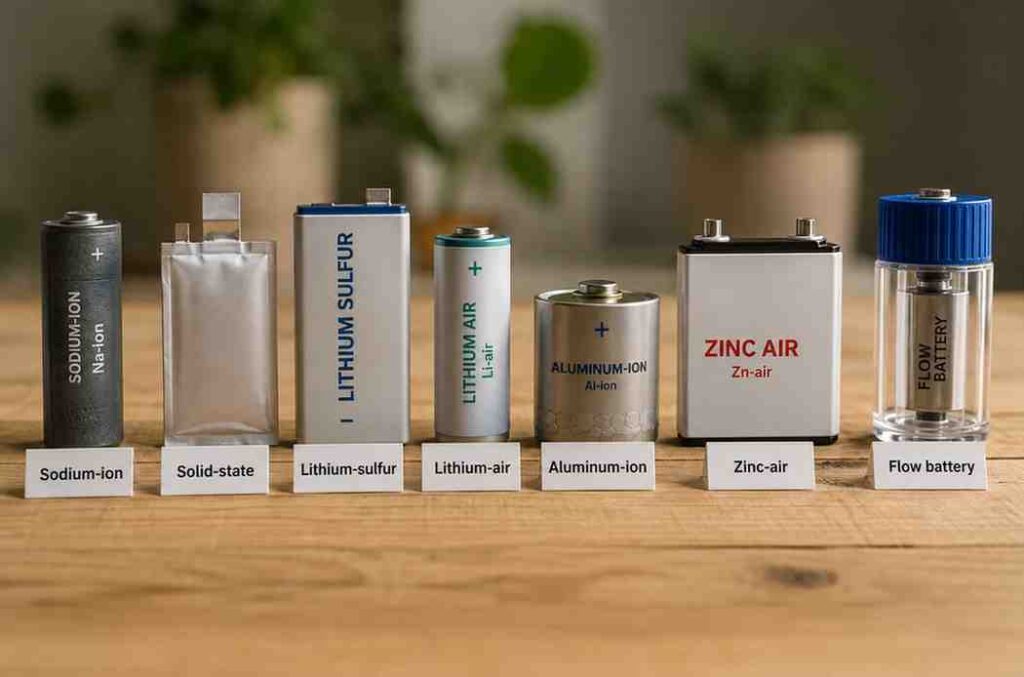
Introduction: The Battery Revolution Is Coming — And It’s Bigger Than You Think
Every time you charge your phone overnight and still find it half-dead by afternoon, you’re experiencing the central frustration of the modern world: our devices are getting smarter, but our batteries can’t keep up.
Lithium-ion batteries have powered the tech revolution for over three decades. They’re in your smartphone, your laptop, your electric car, and increasingly, the power grids that light up entire cities. They were a genuine breakthrough when Sony commercialized them in 1991. But here’s the uncomfortable truth — lithium-ion technology is running out of road.
The chemistry behind these batteries is approaching its theoretical limits. They degrade over time, they can catch fire, they rely on materials like cobalt that are expensive and mined under troubling conditions, and they simply don’t store enough energy to meet the demands of a world racing toward electrification.
The good news? Scientists and engineers around the world are working on the next generation of energy storage — and some of what they’ve developed is nothing short of extraordinary. From batteries that charge in seconds to ones that could power a city for an entire winter, the future of energy storage is being rewritten right now.
Here are 7 future battery technologies that have the very real potential to replace lithium-ion — and change everything from how we drive to how we power our planet.
Why Lithium-Ion Batteries Are Reaching Their Limits
Before diving into the future, it helps to understand why the present isn’t good enough.
Lithium-ion batteries work by moving lithium ions between two electrodes — a cathode and an anode — through a liquid electrolyte. It’s a clever system, but it comes with serious drawbacks:
- Energy density ceiling: No matter how well engineers optimize lithium-ion cells, the chemistry can only store so much energy per kilogram. For electric vehicles to truly compete with gasoline cars on range, we need something fundamentally better.
- Safety risks: The liquid electrolyte is flammable. Battery fires in phones, laptops, and electric vehicles are real, if relatively rare, dangers.
- Degradation: Every charge cycle slightly damages the battery. After 500–1,000 cycles, lithium-ion batteries lose significant capacity — which is why your two-year-old phone doesn’t hold a charge like it used to.
- Supply chain problems: Lithium and cobalt are geographically concentrated resources. The Democratic Republic of Congo supplies over 70% of the world’s cobalt, raising serious ethical and geopolitical concerns.
- Slow charging: Fast charging exists but accelerates degradation. Truly rapid, safe charging remains a challenge.
These aren’t minor inconveniences — they’re fundamental barriers to the clean energy future we need. Which is why the race to replace lithium-ion is one of the most important scientific competitions of our time.
7 Future Battery Technologies That Could Change Everything
1. Solid-State Batteries — The Heir to the Throne
If there’s one technology the entire battery world is watching most closely, it’s solid-state batteries. The concept is elegantly simple: replace the flammable liquid electrolyte in a lithium-ion battery with a solid material — typically ceramic, glass, or a solid polymer.
This single change unlocks a cascade of benefits:
- Higher energy density: Solid electrolytes allow the use of a lithium metal anode instead of graphite, dramatically increasing the amount of energy stored per kilogram.
- No fire risk: Without flammable liquid, the risk of thermal runaway — the chain reaction that causes battery fires — is drastically reduced.
- Longer lifespan: Solid electrolytes are more stable, meaning the battery degrades more slowly over time.
- Faster charging: Solid-state designs can theoretically handle much higher charging rates safely.
Who’s working on it? Toyota, Samsung, QuantumScape (backed by Volkswagen), and Solid Power (backed by BMW and Ford) are among the major players. Toyota has publicly stated it aims to commercialize solid-state batteries for electric vehicles by 2027–2028.
The challenge: Manufacturing solid-state batteries at scale is extremely difficult. The interface between the solid electrolyte and electrodes can crack under repeated expansion and contraction during charging. Engineers are working hard to solve this — and progress is accelerating.
Verdict: Solid-state batteries are not a question of if but when. Most experts believe they will be the dominant battery technology for electric vehicles within the next decade.
2. Sodium-Ion Batteries — Abundant, Affordable, and Almost Ready
What if we could build batteries using one of the most common elements on Earth instead of relatively scarce lithium? That’s exactly what sodium-ion batteries do.
Sodium is chemically similar to lithium — it sits just below lithium on the periodic table and works the same way in a battery, shuttling ions between electrodes during charging and discharging. But sodium is dramatically more abundant: it makes up about 2.6% of Earth’s crust and is found in ordinary table salt. Lithium, by contrast, is concentrated in just a few regions of South America and Australia.
Key advantages:
- Low cost: Sodium is roughly 40–50 times cheaper than lithium. Batteries built from sodium could be significantly less expensive to manufacture.
- No cobalt required: Sodium-ion chemistries work without cobalt, removing one of the most ethically fraught materials in the battery supply chain.
- Better low-temperature performance: Sodium-ion batteries perform better in cold climates than lithium-ion, a critical advantage for electric vehicles in northern regions.
- Safer chemistry: Generally more thermally stable than lithium-ion batteries.
Who’s leading the way? CATL — the world’s largest battery manufacturer — began commercial production of sodium-ion batteries in 2023. BYD and HiNa Battery Technology are also scaling up production rapidly.
The challenge: Sodium ions are larger and heavier than lithium ions, which means sodium-ion batteries currently have lower energy density. They store less energy per kilogram, making them less suitable for long-range electric vehicles in their current form — but ideal for stationary energy storage and shorter-range urban vehicles.
Verdict: Sodium-ion batteries aren’t a distant dream. They’re already being manufactured commercially and could become the dominant technology for budget electric vehicles and grid storage within just a few years.
3. Lithium-Sulfur Batteries — Five Times the Power
Imagine an electric car that could travel 1,000 miles on a single charge — roughly the equivalent of driving from New York to Chicago without stopping. That’s the promise of lithium-sulfur (Li-S) batteries, which have a theoretical energy density up to five times greater than the best lithium-ion batteries available today.
The concept uses sulfur as the cathode material instead of the metal oxides used in lithium-ion batteries. Sulfur is:
- Extraordinarily abundant — it’s a byproduct of oil refining, meaning there’s a near-limitless supply
- Very lightweight, contributing to the exceptional energy density
- Non-toxic and inexpensive
Who’s working on it? Oxis Energy, Lyten (a California-based startup backed by significant venture capital), and researchers at the Monash University in Australia have all made notable advances. Lyten in particular has announced partnerships with major automotive companies to develop Li-S batteries for electric vehicles.
The challenge: The main obstacle has been durability. During charging and discharging, sulfur undergoes large volume changes, physically stressing the battery and causing it to degrade rapidly. Intermediate compounds called “polysulfides” can dissolve into the electrolyte, slowly destroying the battery from within.
Recent breakthroughs using nanostructured sulfur cathodes and advanced electrolyte additives have dramatically extended cycle life — in 2023, researchers achieved over 1,500 charge cycles with minimal degradation, a major milestone for the technology.
Verdict: Lithium-sulfur batteries could be transformative for aviation, long-haul trucking, and premium electric vehicles — applications where every kilogram of battery weight matters enormously.
4. Hydrogen Fuel Cells — Energy Storage Without the Battery
Strictly speaking, hydrogen fuel cells aren’t a battery — but they compete directly with batteries as an energy storage and delivery technology, so they belong in this conversation.
A hydrogen fuel cell generates electricity through a chemical reaction between hydrogen and oxygen, producing only water as a byproduct. The hydrogen is stored in a high-pressure tank and fed into the fuel cell on demand, offering something that batteries fundamentally struggle with: near-instantaneous refueling.
Filling a hydrogen tank takes about 3–5 minutes — comparable to a gasoline fill-up. For battery electric vehicles, even the fastest charging stations take 20–30 minutes for a partial charge.
Real-world adoption today:
- Toyota’s Mirai hydrogen fuel cell sedan has been on sale since 2015
- Hyundai’s NEXO SUV offers a hydrogen-powered option
- Heavy-duty trucking companies are investing heavily in hydrogen, including partnerships with companies like Nikola and Hyzon Motors
- Japan, South Korea, and Germany are building national hydrogen infrastructure
The challenge: Hydrogen is difficult and expensive to produce cleanly. Most hydrogen today is made from natural gas (“grey hydrogen”), which still generates carbon emissions. Green hydrogen — produced by using renewable electricity to split water — is the clean solution, but it remains expensive. Infrastructure is also sparse compared to electric vehicle charging networks.
Verdict: Hydrogen fuel cells are most promising for heavy transport — trucks, trains, ships, and aircraft — where the weight and bulk of large battery packs become impractical. For passenger cars, batteries are likely to win the near-term race.
5. Flow Batteries — The Grid-Scale Game Changer
Here’s a question: what if, instead of storing energy in a fixed solid cell, you stored it in liquid tanks that you could make as big as you needed? That’s the concept behind flow batteries — and for grid-scale energy storage, they might be the most important technology on this list.
In a flow battery, energy is stored in two tanks of liquid electrolyte. When you need electricity, the liquids are pumped through a cell where a chemical reaction releases energy. To charge, you reverse the flow and pump electricity back into the liquids.
Why this is revolutionary for grid storage:
- Infinitely scalable: Need more capacity? Add bigger tanks. It’s that simple — unlike conventional batteries, where adding capacity means adding expensive cells.
- Extremely long lifespan: The core cell components last for decades, and the liquid electrolytes can be replaced or replenished if they degrade.
- No degradation from deep discharge: Flow batteries can be completely discharged without damage — something that shortens the life of lithium-ion batteries significantly.
- Safe: Most flow battery chemistries are non-flammable.
Current leaders: Vanadium redox flow batteries (VRFBs) are the most mature technology, with large installations operating in China, Japan, and the United States. Iron-air flow batteries, developed by companies like Form Energy, promise dramatically lower costs using the cheapest possible materials — iron and air.
Form Energy has announced a battery that can store energy for 100 hours at a cost projected to be under $20 per kilowatt-hour — potentially one-tenth the cost of lithium-ion grid storage.
Verdict: Flow batteries won’t power your electric car. But they could solve one of the biggest challenges of renewable energy: storing the sun’s energy from summer to winter. For grid-scale storage, this technology is a genuine game-changer.
6. Solid-State Lithium-Air Batteries — The Ultimate Energy Dream
If solid-state batteries are the near-future, lithium-air batteries are the far future — and the numbers are almost unbelievable.
A lithium-air battery reacts lithium with oxygen from the surrounding air to store and release energy. Because one of the reactants (oxygen) doesn’t need to be stored inside the battery, the theoretical energy density is astronomically high — potentially 5 to 15 times greater than the best lithium-ion batteries, and comparable to the energy density of gasoline.
Practically speaking, this means a lithium-air battery could power an electric vehicle with a battery pack weighing a fraction of what current packs weigh, or an electric aircraft could become genuinely feasible for long-haul routes.
Who’s working on it? IBM Research, MIT, and the University of Cambridge have all published significant research advances. In 2023, researchers at the Illinois Institute of Technology and Argonne National Laboratory demonstrated a lithium-air battery that could be recharged over 1,000 cycles — a major breakthrough, since earlier versions degraded after just a few dozen cycles.
The challenge: Lithium-air batteries are enormously difficult to stabilize. The reaction with oxygen produces lithium peroxide, which clogs the electrodes and is hard to break down during recharging. Moisture and CO₂ in real air (as opposed to pure oxygen) further degrade the battery. These are hard chemistry problems, not just engineering ones.
Verdict: Lithium-air batteries represent the theoretical ceiling of electrochemical energy storage. Commercial viability is likely 15–25 years away at minimum, but the research is progressing. When — or if — these batteries are commercialized, they will be genuinely revolutionary.
7. Sand Batteries and Thermal Storage — Thinking Outside the Battery
The final entry on this list is the most unconventional — and in some ways, the most immediately practical. Sand batteries (and thermal energy storage more broadly) challenge the very definition of what a “battery” needs to be.
In 2022, a power company in Finland made global headlines by building the world’s first commercial sand battery. The concept is almost absurdly simple: heat sand to extremely high temperatures (up to 600°C / 1,112°F) using excess renewable electricity, then store that heat in a large, insulated silo of sand. When heat is needed — for district heating systems that warm homes and buildings — it’s drawn from the sand.
Why sand?
- Sand is extraordinarily cheap and abundant — essentially free
- Sand can hold heat for months without significant loss
- The system is completely non-toxic, non-flammable, and has no complex chemistry
- Charging efficiency is very high — nearly all the electricity used to heat the sand is stored as heat
The Finnish installation, built by Polar Night Energy in the city of Tampere, stores enough energy to heat hundreds of homes through the dark Finnish winter.
The limitation: Thermal storage converts electricity to heat — and converting that heat back to electricity is inefficient. This technology works best when heat itself is the desired output (space heating, industrial processes), not when electricity generation is the goal.
Verdict: Sand batteries won’t power your electric vehicle. But for decarbonizing home heating, district heating systems, and industrial heat demand — which represent a massive portion of global energy consumption — this technology is available right now, at remarkably low cost.
Comparing the 7 Technologies at a Glance
| Technology | Readiness | Best Use Case | Key Advantage |
|---|---|---|---|
| Solid-State | 3–7 years | EVs, Consumer Electronics | Safety + Energy Density |
| Sodium-Ion | Now | Budget EVs, Grid Storage | Low Cost + Abundance |
| Lithium-Sulfur | 5–10 years | Aviation, Long-Range EVs | Extreme Energy Density |
| Hydrogen Fuel Cells | Now (limited) | Heavy Transport | Fast Refueling |
| Flow Batteries | Now (grid only) | Grid-Scale Storage | Scalability + Longevity |
| Lithium-Air | 15–25 years | Future EVs, Aircraft | Theoretical Peak Density |
| Sand/Thermal | Now | Heating, Industrial | Ultra-Low Cost |
The Common Thread: A World Beyond Fossil Fuels
These seven technologies aren’t competing with each other — they’re solving different pieces of the same massive puzzle. The world doesn’t need one perfect battery. It needs a portfolio of storage solutions matched to specific applications:
- Small, light, ultra-dense batteries for phones and aircraft
- Safe, affordable batteries for everyday electric vehicles
- Massive, cheap storage for renewable energy grids
- Fast-refueling solutions for long-haul trucks and ships
The lithium-ion era gave us portable electronics and launched the electric vehicle revolution. But the next era of energy storage will be defined not by one chemistry, but by several — each optimized for its purpose, each enabling a world that runs cleaner, cheaper, and smarter than the one we live in today.
Conclusion: The Battery Age Has Only Just Begun
We are living through one of the most important technological transitions in human history — the shift from fossil fuels to stored electrical energy. And the batteries we use today are just the beginning of that story.
Solid-state batteries will make electric vehicles safer and longer-range. Sodium-ion batteries will make them affordable for everyone. Flow batteries will store the sun’s summer energy through the dark of winter. And somewhere in a laboratory right now, a chemist is solving the problem that will make the next breakthrough possible.
The age of the lithium-ion battery is not over — but its reign as the only option certainly is. The future of energy storage is diverse, exciting, and coming faster than most people realize. And when it arrives, it will change not just how we power our devices, but how we power our civilization.