
Introduction: Your Body Is a Living Museum of Evolution
Take a moment and feel the back of your lower spine. That small, triangular bone you just touched? You don’t need it anymore — at least not the way your ancient ancestors did. It’s called the coccyx, or tailbone, and it’s one of the most fascinating relics of human evolution sitting right inside your body.
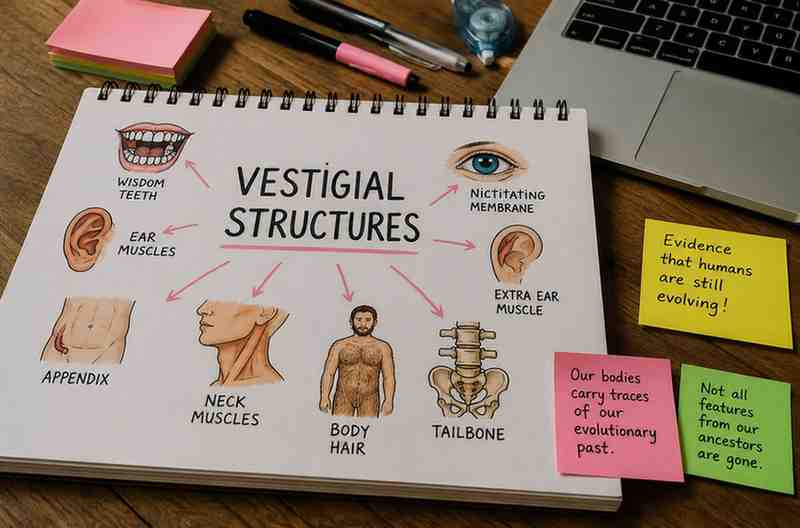
We like to think of ourselves as the finished product of millions of years of natural selection. But the truth is far more interesting: the human body is still a work in progress. Buried within our anatomy are leftover structures — called vestigial organs — that once served a purpose for our evolutionary ancestors but now do little or nothing at all.
These biological leftovers aren’t just medical curiosities. They’re powerful evidence that human evolution is real, ongoing, and written in our very bones and tissues. From muscles you’ve never knowingly used to organs your doctor probably wants to remove, these structures tell the story of where we came from — and hint at where we’re headed.
In this article, we’ll explore the top 10 vestigial structures in the human body, explain what they used to do, why they’re still here, and what they reveal about our evolutionary past. Whether you’re a curious student, a science enthusiast, or just someone who wonders why wisdom teeth exist, you’re in the right place.
What Are Vestigial Structures? (A Quick Primer)
The term “vestigial” comes from the Latin word vestigium, meaning “footprint” or “trace.” In biology, a vestigial structure is any organ, tissue, or body part that has lost most or all of its original function through evolution, yet still remains in the body.
These structures don’t appear by accident. They’re inherited from ancestors who actually needed them. Over generations, as environments and lifestyles changed, these features became less useful — but evolution is slow. It doesn’t instantly delete what it no longer needs. Instead, these features gradually shrink, weaken, or become inactive over thousands of generations.
Here’s a key point: vestigial doesn’t always mean completely useless. Some vestigial structures have taken on minor secondary functions. But their original, primary purpose is largely gone.
Top 10 Vestigial Structures in the Human Body
1. The Coccyx (Tailbone) — Your Inner Tail
Let’s start with the most iconic one. The coccyx, located at the very base of your spine, is made up of three to five fused vertebrae. In our distant primate ancestors, this structure was a full, functioning tail — used for balance, communication, and gripping branches.
As humans evolved to walk upright and moved away from tree-dwelling life, the tail gradually shortened and eventually fused into the small stub we have today.
Does it do anything now? Technically, yes — a little. The coccyx serves as an attachment point for certain pelvic floor muscles and ligaments. But it’s nowhere near necessary for survival. People who have their coccyx removed due to injury report very few lasting problems.
Fun fact: In rare cases, babies are born with a small soft-tissue tail — a direct genetic throwback to our tailed ancestors. These are almost always removed surgically after birth.
2. The Appendix — More Than Just Trouble?
The appendix is probably the most famous vestigial organ. This small, finger-shaped pouch hangs off the large intestine in the lower right abdomen. For centuries, scientists believed it had no function whatsoever — existing only to cause appendicitis.
In our herbivorous ancestors, the appendix was likely much larger and played a role in digesting tough plant material, particularly cellulose. As the human diet evolved, this function disappeared.
Recent research, however, suggests the appendix may still play a minor immune role. Some scientists believe it acts as a “safe house” for beneficial gut bacteria — helping to re-seed the gut after illness. But here’s the important part: people who have their appendix removed live perfectly normal, healthy lives with no immune deficiency. This tells us the organ’s role, whatever it may be, is not essential.
3. Wisdom Teeth — The Jaw You No Longer Have
Most adults develop a third set of molars between ages 17 and 25 — commonly called wisdom teeth. These teeth were vital for our ancestors, who had larger jaws and ate rough, unprocessed diets of roots, nuts, leaves, and raw meat. The extra molars helped grind down that tough diet.
As cooking and food processing reduced the need for heavy chewing, human jaws gradually became smaller. The problem? Our genetic blueprint still includes the code for those extra teeth. The result is a painful mismatch: wisdom teeth that often have no room to emerge, growing at odd angles, causing crowding, pain, and infections.
Around 85% of people need their wisdom teeth removed at some point in their lives. Some people are now born without wisdom teeth at all — a sign that evolution may eventually phase them out entirely.
4. The Palmaris Longus — The Muscle You Might Not Have
Hold your arm out flat and touch your pinky finger to your thumb. Do you see a thin tendon pop up in the middle of your wrist? If so, you have the palmaris longus muscle. If you don’t see one — congratulations, you’re slightly more evolved.
This forearm muscle was crucial for our tree-climbing ancestors, helping them grip and hang from branches with great strength. Today, it contributes almost nothing meaningful to grip strength in modern humans.
About 14% of people are born without this muscle in one or both arms. And here’s the real proof of its uselessness: surgeons regularly harvest the palmaris longus tendon for reconstructive surgeries elsewhere in the body — like repairing damaged tendons in the hand — and patients experience no loss of strength or function in the donor arm.
5. The Plantaris Muscle — Evolution’s Expendable Leg Muscle
Hidden in the back of your calf is the plantaris muscle — a long, thin muscle with an extremely long tendon. In other primates, this muscle plays an important role in gripping with the feet (think of how monkeys use their feet almost like a second pair of hands). In humans, who walk upright on flat feet, this function is essentially obsolete.
The plantaris contributes so minimally to movement that about 9% of people are born without it entirely, with no impact on walking, running, or athletic performance. Like the palmaris longus, surgeons sometimes use its tendon for reconstructive procedures because it simply isn’t needed where it is.
6. Darwin’s Tubercle — The Ear Tip That Hid Your Pointy Past
Look at the outer rim of your ear and feel for a small, thickened bump near the upper portion. If you find one, that’s called Darwin’s Tubercle — named after Charles Darwin himself, who pointed it out in his landmark work The Descent of Man.
This little bump is a remnant of the pointed, mobile ear tips that many mammals have. In animals like cats, dogs, and primates, pointed, mobile ears help them locate sounds more precisely — rotating toward the source of a noise for better directional hearing. Human ears are relatively fixed and rounded, a sign that we’ve long since stopped relying on mobile ear tips.
Darwin’s Tubercle appears in roughly 10–40% of people and varies widely in size and prominence. It causes no problems and serves no known function — a tiny evolutionary souvenir written on your ear.
7. Goosebumps (Arrector Pili Muscles) — Fear Without the Fur
Have you ever felt a chill run through you and noticed tiny bumps pop up on your skin? Those are goosebumps, caused by small muscles called arrector pili attached to the base of each body hair follicle.
In our fur-covered ancestors, these muscles served two important purposes:
- Thermoregulation: Raising hair created a layer of insulating air close to the skin, trapping warmth.
- Defense: Puffing up fur made animals look larger and more threatening to predators or rivals.
Humans lost most of our body fur over hundreds of thousands of years. But the arrector pili muscles remain, faithfully doing their job — only now, without enough fur to make a difference. The result is decorative bumps that neither warm us up nor scare anyone away.
8. The Nictitating Membrane — Your Hidden Third Eyelid
Look closely at the inner corner of your eye — that small, pinkish fold of tissue is called the plica semilunaris. It’s the remnant of a nictitating membrane, or third eyelid.
Many animals — including birds, reptiles, sharks, and some mammals — have a fully functional third eyelid. It sweeps horizontally across the eye to clear debris, protect the surface during hunting or swimming, and keep the eye moist without fully closing.
In humans, the plica semilunaris is a shrunken, largely non-functional leftover. It no longer moves across the eye and plays no significant role in vision or eye protection. It is, however, used as a surgical landmark in certain eye procedures — one of the few remaining practical uses of a once-critical structure.
9. Sinuses — Mysterious Cavities With a Foggy Past
Your paranasal sinuses — the hollow cavities in your skull around the nose — are poorly understood even by modern medicine. These air-filled spaces are famous for causing misery during colds and allergies, yet their exact evolutionary purpose remains debated.
Proposed past functions include reducing skull weight, humidifying and warming inhaled air, and enhancing the resonance of the voice. Some researchers believe they were once more structurally important in ancestors with larger, differently shaped skulls.
Today, the sinuses seem disproportionately prone to infection and blockage relative to any benefit they provide — a classic sign of a structure that hasn’t kept pace with the rest of our anatomy.
10. Male Nipples — Evolution’s Copy-Paste Error
Perhaps the most commonly discussed vestigial feature is male nipples. Unlike most vestigial structures, this one has a very clear explanation.
In the earliest stages of fetal development — before sex hormones begin differentiating male and female anatomy — all embryos follow the same developmental blueprint. Nipples develop during this early, undifferentiated stage. Only later does testosterone trigger male development, but by then, the nipples are already formed.
Male nipples serve no reproductive function, produce no milk under normal circumstances, and offer no evolutionary advantage. They persist simply because they appear before the developmental “fork in the road” between male and female anatomy — a harmless carry-along from our shared developmental code.
What Vestigial Structures Tell Us About Human Evolution
The existence of vestigial structures delivers one of the clearest, most tangible arguments for evolution. These aren’t just theoretical concepts — they’re physical features you can touch, see, and in some cases, feel causing you pain.
Here’s what they collectively prove:
- We share ancestry with other animals. Structures like the nictitating membrane and Darwin’s Tubercle make zero sense unless we share common ancestors with creatures that needed them.
- Evolution doesn’t design — it modifies. Natural selection works with what already exists. It can reduce or repurpose structures, but removal is a slow, generational process.
- The human body is still changing. The fact that some people are born without a palmaris longus or wisdom teeth shows evolution in action, right now.
Conclusion: Your Body Tells a 3.5-Billion-Year Story
Every time you get a headache from your sinuses, wince at a wisdom tooth, or feel goosebumps on a cold day, you’re experiencing echoes of an ancient past. The human body is not a perfect machine — it’s an evolving one. And that imperfection, that beautiful mess of repurposed parts and evolutionary leftovers, is exactly what makes it extraordinary.
Vestigial structures are not flaws. They’re chapters in the ongoing story of life on Earth — a story that includes ancient tree-climbers, fur-covered mammals, creatures with tails and mobile ears, and somewhere at the very beginning, simple single-celled organisms floating in primordial seas.
Understanding these structures doesn’t diminish what we are. It reveals the remarkable, improbable journey that brought us here — and reminds us that the story isn’t finished yet.
Frequently Asked Questions (FAQ)
Q1: Are vestigial structures completely useless? Not always. Some vestigial structures retain minor secondary functions — like the coccyx anchoring pelvic muscles or the appendix possibly housing gut bacteria. However, their original primary function has largely disappeared, and most people live perfectly healthy lives without them.
Q2: Does having a vestigial structure mean I’m less evolved? No. Having features like a palmaris longus or Darwin’s Tubercle doesn’t make you “less evolved.” Evolution works on populations over thousands of generations, not on individuals. Variation in these features is perfectly normal and natural.
Q3: Can vestigial organs cause health problems? Yes, in some cases. Wisdom teeth are a prime example — they frequently cause pain, crowding, and infection because they no longer fit properly in the modern human jaw. The appendix can also become infected (appendicitis), requiring removal. Most vestigial structures, however, are harmless.
Q4: Will humans eventually lose all vestigial structures? Possibly, over extremely long timescales — but only if there’s selective pressure against them. If a structure isn’t actively harmful, natural selection may simply ignore it rather than remove it. Some features, like wisdom teeth, may disappear sooner because they do cause problems that affect survival and reproduction.
Q5: How many vestigial structures does the human body have? Estimates vary, but researchers have identified anywhere from 86 to over 100 potentially vestigial structures in the human body. The ten in this article are among the most well-documented and widely recognized by scientists and anatomists.