
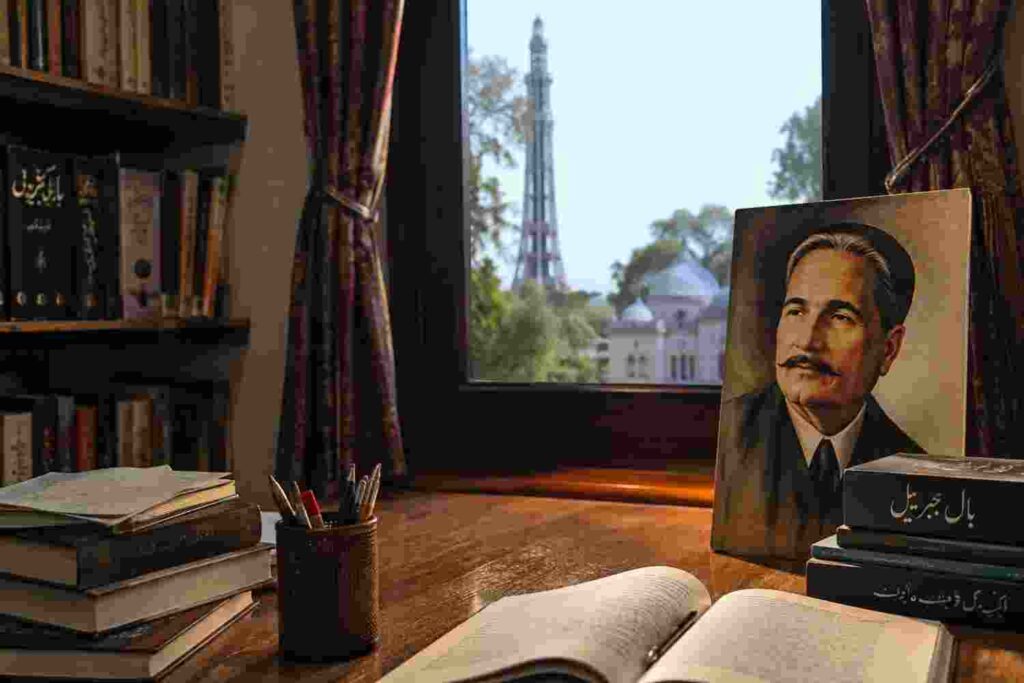
Introduction: The Poet Who Spoke Directly to You
Nearly nine decades have passed since Allama Iqbal left this world. His name graces school assemblies, public monuments, national holidays, and the currency of a nation he helped imagine into existence. His couplets are memorized by schoolchildren from Karachi to Kabul, from Lahore to London.
And yet — as one young Pakistani writer observed with painful honesty — <cite index=”13-1″>Iqbal is often remembered but rarely understood. His Shaheen and the idea of Khudi still hold a blueprint for youth in a distracted age. Iqbal didn’t write for youth just to have his couplets and poetries recited in speeches or carved in monuments. He wrote for minds. He wrote for rebels, for dreamers, visionaries who carry the future of this nation.</cite>
This is the gap this article is written to close.
Allama Muhammad Iqbal — <cite index=”10-1″>Muslim philosopher, poet, writer, scholar and politician of early 20th-century, known in the Indian subcontinent for his Urdu philosophical poetry on Islam and the need for the cultural and intellectual reconstruction of the Islamic community</cite> — was not writing for monuments. He was writing for the young Muslim who stares at the ceiling at night wondering what they are worth. For the student who feels the weight of history and the paralysis of the present. For the dreamer who senses greatness within but has been taught, by circumstance and conditioning, to doubt it.
He was writing for you.
The verses, the symbols, the philosophies explored in this article are not museum pieces. They are live instruments — tools of the most practical kind for navigating the specific challenges of modern Muslim youth: the crisis of identity, the seduction of passivity, the hunger for purpose, and the deep, unmet longing to matter.
Read them not as literature. Read them as instruction.
The Man Behind the Message: Who Was Allama Iqbal?
Before the lessons, the life — because Iqbal’s philosophy cannot be separated from the experience that forged it.
Muhammad Iqbal was born on November 9, 1877, in Sialkot in the Punjab region of British India, into a family of modest means but deep spiritual roots. His father, Sheikh Noor Muhammad, was a devout man with a love of Sufism and learning — the earliest influence on a son who would spend his life at the intersection of faith and philosophy.
He was educated brilliantly — first in Sialkot, then at Government College Lahore, then at Trinity College Cambridge where he read philosophy, and finally at the Ludwig Maximilian University of Munich where he completed a doctorate on the development of metaphysics in Persia. He read Kant, Hegel, Nietzsche, Bergson, and Rumi with equal depth, absorbing Western philosophy while remaining rooted in the Islamic intellectual tradition.
<cite index=”11-1″>Iqbal wrote both in Persian and Urdu, and is often regarded as the poet-philosopher of the East who addressed the Muslim ummah, believed in the philosophy of wahdatul wujood, and propounded the philosophy of khudi, or selfhood, which called for self-realisation and the discovery of the hidden talent with love and perseverance. His poetry emerged as a remarkable site where message and art coalesced, as he re-configured major poetic devices like metaphor, myth, and symbol to re-visit history, philosophy and the Islamic faith to develop his individual vision.</cite>
He returned from Europe changed — not Westernized, but sharpened. The encounter with Western thought had clarified for him, with painful precision, what the Muslim world had lost and what it urgently needed to recover. The result was a body of poetry and philosophical prose that addressed that need with extraordinary directness, beauty, and force.
<cite index=”22-1″>His questions remain alive today. Can a community’s identity rest on faith rather than territory? How should religion and politics relate in a modern state? His concept of ijtihad continues to inform debates about reform in Islamic law, and his idea of selfhood still speaks to anyone thinking about confidence, agency and renewal. He was a patriot who became a separatist, a critic of the West who used Western tools, a mystic who championed action.</cite>
He died on April 21, 1938 — nine years before the nation he had envisioned came into existence. He never saw Pakistan. But Pakistan, in a very real sense, is his vision given geographical form.
Why Iqbal Focused So Intensely on Youth
Before exploring the individual lessons, it is worth asking: why youth? Why did Iqbal direct so much of his most urgent, most passionate poetry specifically toward the young?
The answer lies in his diagnosis of the Muslim world’s condition.
Iqbal looked at the Muslim ummah in the early 20th century — colonized, internally divided, intellectually stagnant, politically marginalized — and concluded that the root cause was not external. The armies of the colonizers were powerful, but the deeper problem was internal: a loss of self-belief, a retreat into passivity, a substitution of ritual for genuine spiritual and intellectual vitality.
<cite index=”12-1″>One of the core principles of Iqbal’s thought is that individual transformation leads to societal change.</cite> If the Muslim world was to be revived, it would not happen through politics alone, or through military power, or through institutional reform imposed from above. It would happen through the transformation of individuals — specifically, through the transformation of the generation that had not yet calcified into the habits of defeat.
Youth, for Iqbal, was not just a biological category. It was a spiritual condition — the capacity for vision, for energy, for the willingness to be remade. <cite index=”16-1″>Iqbal viewed the youth as the true builders of tomorrow, believing deeply in their passion, energy, and creative potential. Through countless poems, he guides young people to dream boldly, work hard, stay disciplined, build character, and shape a strong, visionary future.</cite>
These are the lessons he left for that generation — and for every generation after it.
Lesson 1: Know Your Khudi — The Revolution Begins Within
The Philosophy
No single concept is more central to Iqbal’s thought than Khudi — a Urdu and Persian word that translates approximately as “selfhood,” “self-awareness,” or “the self,” but carries depths of meaning that no single English word can capture.
<cite index=”14-1″>Asrar-i-Khudi (The Secrets of the Self), published in Persian in 1915, was the first philosophical poetry book of Allama Iqbal. This book deals mainly with the individual, while his second book Rumuz-i-Bekhudi (Mysteries of Selflessness) discusses the interaction between the individual and society.</cite>
Iqbal’s Khudi is not ego or arrogance — a distinction he made with great care. <cite index=”16-1″>Khudi is not arrogance or ego; it is the realization of one’s inner strength, spiritual awakening, and disciplined self-growth. When a person understands, nurtures, and elevates their Khudi, they rise above limitations and transform into a powerful, extraordinary, and impactful personality.</cite>
The philosophy is expressed most powerfully in what is arguably Iqbal’s most famous couplet:
خودی کو کر بلند اتنا کہ ہر تقدیر سے پہلے خدا بندے سے خود پوچھے، بتا تیری رضا کیا ہے
“Elevate your selfhood to such heights that before every destiny is written, God Himself asks the servant: ‘Tell me — what is your will?'”
This verse is breathtaking in its ambition. It is not saying that a human being becomes equal to God. It is saying that the human being who has fully realized and elevated their God-given potential enters into such a profound relationship with the Divine that their will becomes aligned with God’s will — that God’s decree and the person’s deepest aspiration become one.
<cite index=”13-1″>Khudi is forged in struggle, in reflection, in solitude, and in the pursuit of truth and the right path with a strong and firm belief in the Creator. It demands us to dig beneath the surface of our own existence: Who am I? What am I made for?</cite>
The Modern Application
The Khudi lesson speaks with extraordinary directness to the identity crisis that many young Muslims face in the modern world — caught between cultures, uncertain of their place, sometimes ashamed of their heritage and sometimes alienated from the culture around them.
Iqbal’s answer to this crisis is not accommodation or assimilation — it is the deepening of self-knowledge. Before you can know where you belong in the world, you must know who you are. Before you can contribute to humanity, you must discover what is uniquely, irreplaceably yours to contribute.
This is a deeply Islamic understanding. The Quran repeatedly calls human beings to reflection on themselves: “And on the earth are signs for those of certain faith, and in yourselves. Then will you not see?” (Quran 51:20-21). Iqbal poeticized this Quranic imperative into a philosophical program.
Practical questions the Khudi lesson asks of you:
- What are the God-given capacities within you that you have not yet developed?
- What do you consistently avoid because it feels too difficult — and is that avoidance a denial of your Khudi?
- In what areas of your life are you waiting for permission, validation, or external circumstances to change — when the actual change required is internal?
Lesson 2: Be the Shaheen — Reject Comfortable Cages
The Philosophy
If Khudi is Iqbal’s central philosophical concept, the Shaheen (the falcon or eagle) is his most enduring symbol — the image through which he communicates what a fully realized Muslim youth should look like.
<cite index=”9-1″>At the heart of Allama Iqbal’s philosophy lies his call for individuals, particularly the youth, to embody the qualities of the Shaheen: strength, independence, and unwavering self-reliance. Through his poetry, Iqbal urges his readers to break free from the chains of dependency and aspire to their highest potential. In Iqbal’s vision, true strength lies within — Khudi, or selfhood, which can only be achieved through discipline and courage. The Shaheen, indifferent to worldly comforts, thrives in solitude and challenge, rising ever higher.</cite>
The Shaheen appears across dozens of Iqbal’s poems, always carrying the same constellation of qualities:
High flight — the Shaheen does not settle on low ground. It seeks altitude — not because altitude is comfortable, but because altitude is where it was meant to be.
Independence — the Shaheen does not depend on the leavings of others. It hunts its own prey. Iqbal contrasts the Shaheen unfavorably with the crow and the pigeon — birds that eat whatever they find, wherever they find it, without pride or independence.
Far-sightedness — <cite index=”15-1″>the Shaheen is far-sighted</cite>. It sees from heights that smaller birds cannot reach, identifying what is distant and significant while others are consumed by what is immediate and trivial.
Comfort with solitude — the Shaheen is not a flock bird. It soars alone. For Iqbal, this is not loneliness — it is the condition of genuine individual development. True growth requires periods of solitude, reflection, and the willingness to be separate from the crowd.
Fearlessness — the Shaheen does not fear storms. It rides them.
Iqbal’s most direct address to youth as Shaheen appears in this famous verse:
شاہیں کبھی پرواز سے تھک کر نہیں گرتا پردہ ہے ہر شاخ پر آشیاں اس کا
“The falcon never falls from weariness in its flight. Every branch is a veil — not its nest.”
<cite index=”13-1″>Why did Allama Iqbal choose the Shaheen and not any other bird to address the young generation? Throughout his poetry Allama Iqbal compares the youth with the ‘high status’ Shaheen and urges them to imitate the amazing bird.</cite>
The answer lies in the Shaheen’s most defining characteristic: it never nests in borrowed branches. It never makes a temporary resting place its permanent home. It keeps moving — always upward, always forward, always toward the next horizon.
The Modern Application
The Shaheen metaphor addresses one of the most dangerous spiritual conditions that afflicts modern Muslim youth: comfortable captivity.
Many young people today are not in obvious cages. They have phones, entertainment, social media, decent jobs, comfortable homes. The cage is invisible — made not of iron but of habit, distraction, low expectation, and the intoxicating ease of a life that demands nothing and produces nothing lasting.
<cite index=”12-1″>Scholars point out that the concept of Shaheen embodies key qualities including foresight, fearlessness, independence, contemplation, and resilience — values that resonate strongly with today’s youth.</cite>
Iqbal’s Shaheen lesson asks uncomfortable questions:
- What is your “borrowed branch” — the comfortable situation you have settled into that was never meant to be your permanent home?
- Are you building your life toward something, or simply maintaining a comfortable existence?
- What would you attempt if you were not afraid of the discomfort it would require?
The Shaheen does not ask these questions anxiously. It simply flies — because flying is its nature. Iqbal’s invitation is to remember your own nature, and to refuse any life that asks you to forget it.
Lesson 3: Ishq — The Love That Drives Everything
The Philosophy
Iqbal’s philosophy is not built on cold reason or dry intellectual exercise. At its emotional core is Ishq — a word that translates as “love” but carries a depth and intensity that ordinary love language does not convey.
For Iqbal, Ishq is not merely romantic feeling. It is the transforming power at the heart of all genuine human achievement — the fire that drives the Shaheen’s flight, that forges the Khudi, that moves history. It is love of God, love of the Prophet (PBUH), love of truth, love of justice, and love of the ideal that burns so deeply it overrides every comfort and every fear.
Iqbal places Ishq in direct contrast with mere Aql (intellect or reason):
عقل عیار ہے سو بھیس بدلتی ہے عشق بیچارہ نہ ملاّ ہے نہ زاہد
“Intellect is cunning — it changes its disguise a hundred times. Love, poor thing, is neither a cleric nor an ascetic.”
Intellect, for Iqbal, is a necessary tool but a limited master. It calculates, hedges, and retreats when the path becomes dangerous. Ishq does not calculate — it commits. And it is commitment, not calculation, that changes the world.
The highest expression of Ishq for Iqbal is love of Allah and the Prophet (PBUH) — a love that reorganizes the entire personality around a sacred center, so that all other loves and pursuits derive their meaning from that central relationship.
عشق کی تیغ سے ڈرتا ہے زمانہ تجھ سے کیوں نہ ڈرے، تو نے توڑا ہے کفر کا سلسلہ
“The world fears the sword of your love. Why should it not fear? You have broken the chain of disbelief.”
The Modern Application
The Ishq lesson speaks to perhaps the deepest hunger of modern youth — the hunger for meaning, for something genuinely worth caring about.
Much of contemporary life is characterized by ironic detachment — the cultural norm that suggests genuine passion is naive, that commitment is embarrassing, that caring deeply about anything is a vulnerability to be avoided. Social media in particular rewards performative cynicism over genuine enthusiasm.
Iqbal’s answer to this cultural condition is direct and uncompromising: a life without Ishq is not a life. It is merely an existence — comfortable perhaps, respectable perhaps, but ultimately empty and historically weightless.
The Ishq lesson for modern youth:
- Find what you love with the intensity that Iqbal means by Ishq — not what you enjoy or prefer, but what you would sacrifice comfort and convenience for
- Root that love in something larger than yourself — in God, in truth, in justice, in the service of humanity
- Let that love reorganize your priorities, your time, and your choices — because Ishq, by definition, changes everything it touches
Lesson 4: Ijtihad — Think for Yourself Within the Tradition
The Philosophy
<cite index=”22-1″>Iqbal laid out his philosophy systematically in The Reconstruction of Religious Thought in Islam, a series of lectures published in 1930. He argued that the Muslim world’s decline came from intellectual stagnation, particularly the abandonment of ijtihad, the principle of independent reasoning. He famously called ijtihad the principle of movement in the structure of Islam.</cite>
Ijtihad — the Islamic jurisprudential concept of independent reasoning applied to derive rulings from primary sources — had been effectively restricted in the classical period of Islamic law. Iqbal argued that this restriction had been catastrophic: it transformed a dynamic, forward-moving faith into a static system of inherited opinion, incapable of responding to changing circumstances with the creativity that Islamic civilization had once displayed.
<cite index=”23-1″>In Reconstruction, Iqbal critiques rigid scholasticism (taqlid) within Islamic orthodoxy and calls for ijtihad — independent reasoning — to reinterpret core doctrines like the nature of God, prophecy, and human purpose in light of empirical science, Western philosophy, and the Quran’s emphasis on a dynamic, evolving universe.</cite>
<cite index=”20-1″>The Muslim community in the present age ought, through the exercise of ijtihad — the principle of legal advancement — to devise new social and political institutions.</cite>
This was a revolutionary claim, and Iqbal made it with full awareness of its implications. He was not advocating abandoning the Quran and Sunnah. He was advocating the engagement of living, trained Muslim intellects with contemporary reality — bringing the light of Islamic principles to bear on new circumstances rather than retreating into the comfort of inherited answers to questions that had not yet been asked.
<cite index=”22-1″>Iqbal proposed that the right to interpret Islamic law should no longer rest with individual jurists alone but with representative legislative assemblies expressing the collective conscience of the community. This idea of “spiritual democracy” tried to blend Islamic principles with modern democratic forms.</cite>
The Modern Application
The Ijtihad lesson is perhaps Iqbal’s most demanding challenge for modern Muslim youth — because it requires exactly what comfortable religious culture often discourages: rigorous, independent, respectful thinking.
Many young Muslims oscillate between two equally problematic positions: either uncritical adoption of inherited religious opinion without understanding its reasoning, or wholesale rejection of tradition in favor of secular modernity. Iqbal’s Ijtihad lesson charts a different course — the hard, narrow path of genuine intellectual engagement.
This means:
- Study deeply — not just the conclusions of Islamic scholarship but its reasoning, its methodology, and its engagement with the questions of its own time
- Think seriously about how Islamic principles apply to contemporary circumstances — technology, economics, bioethics, political organization, environmental responsibility
- Engage Western thought without being colonized by it — as Iqbal himself did, using Western philosophical tools to sharpen Islamic arguments without losing Islamic foundations
- Respect tradition while not being paralyzed by it — tradition is a resource, not a cage
The Muslim youth who takes Ijtihad seriously becomes exactly what Iqbal envisioned: a person capable of bringing Islamic wisdom to bear on modern problems with rigor, creativity, and genuine understanding.
Lesson 5: The Power of Action — Ilm Without Amal Is Incomplete
The Philosophy
Iqbal was deeply suspicious of a particular kind of religious Muslim — the one who knows everything and does nothing. For Iqbal, knowledge divorced from action was not wisdom — it was decoration. The highest human state was not contemplation alone but the integration of deep knowledge with bold, purposeful action in the world.
This conviction placed him in creative tension with certain strands of classical Sufism that emphasized withdrawal from the world as the path to spiritual perfection. Iqbal honored the Sufi tradition’s depth of spiritual insight while challenging its tendency toward quietism:
عمل سے زندگی بنتی ہے جنت بھی جہنم بھی یہ خاکی اپنی فطرت میں نہ نوری ہے نہ ناری
“Life is shaped by action — into paradise or into hell. This being of dust is, by its nature, neither of light nor of fire.”
And most directly:
ہزار خوف ہو لیکن زبان ہو دل کی رفیق یہی رہا ہے ازل سے قلندروں کا طریق
“A thousand fears may surround you, but let your tongue be companion to your heart. This has always been the way of the free.”
Iqbal’s model was not the monk but the warrior-scholar — the figure who combines inner spiritual depth with outward purposeful engagement. His heroes from history were the same: the early Muslim scholars who were also statesmen, the generals who were also jurists, the mystics who led armies.
<cite index=”12-1″>His philosophy encourages youth to pursue knowledge, embrace challenges, and contribute positively to society.</cite>
The Modern Application
The action lesson confronts a specific pathology of educated Muslim youth: analysis paralysis — the tendency to understand problems deeply without doing anything about them.
Iqbal’s message is not anti-intellectual. He was one of the most formidably educated men of his era. His message is anti-passivity. The person who reads deeply about the condition of the Muslim world and then does nothing has not honored the knowledge they’ve acquired.
The action lesson asks:
- What do you know that obligates you to act?
- What have you been planning, studying, or discussing — and never starting?
- What is the smallest, most immediate action available to you today that moves in the direction of your purpose?
Iqbal’s poetry is not a comfortable place to rest. It is a challenge to move.
Lesson 6: Know Your History — The Muslim Who Forgets the Past Has No Future
The Philosophy
One of the most consistent themes across Iqbal’s poetry is the call to historical consciousness — to a living, emotionally engaged relationship with the extraordinary legacy of Islamic civilization.
Iqbal believed that a people disconnected from their history are a people without roots — and rootless people cannot build anything lasting. The Muslim youth who does not know what Islamic civilization produced at its height — the mathematics, the medicine, the philosophy, the architecture, the literature, the political thought — is a person who does not know what they are capable of.
His Shikwa (Complaint) and Jawab-e-Shikwa (Answer to the Complaint) — among the most celebrated poems in Urdu literature — are precisely this: a conversation between Muslim consciousness and God, in which the Muslim complains of his fallen state and God responds by reminding him of what he has abandoned of his own tradition.
In Jawab-e-Shikwa, the divine response is devastating in its clarity:
وہ زمانے میں معزز تھے مسلماں ہو کر اور تم خوار ہوئے تارکِ قرآں ہو کر
“They were honored in the world by being Muslim. And you have been disgraced by abandoning the Quran.”
This is not a verse of self-pity or fatalism. It is a diagnosis — and diagnoses, by their nature, point toward treatment.
<cite index=”12-1″>Dr Iqbal’s concept of Khudi played a pivotal role in inspiring Muslims of the subcontinent to strive for freedom and ultimately achieve independence after creation of Pakistan on August 14, 1947.</cite>
The Modern Application
The historical consciousness lesson addresses one of modern Muslim youth’s most widespread forms of cultural poverty: ignorance of the Islamic Golden Age and its implications.
Many young Muslims have internalized, often unconsciously, a narrative in which Islamic civilization has always been peripheral to the main story of human intellectual progress — a narrative in which science, philosophy, mathematics, and medicine were European achievements with Islamic contributions as footnotes.
This narrative is historically false. The Islamic Golden Age (roughly 8th–13th centuries CE) produced Al-Khawarizmi’s algebra, Ibn Sina’s medical canon used in European universities for six centuries, Al-Biruni’s anthropology, Ibn Rushd’s philosophy that kept Aristotelian thought alive for the Western Renaissance, Al-Idrisi’s cartography, and Ibn Battuta’s unmatched geographical observation.
Iqbal’s historical lesson for youth:
- Study Islamic intellectual history with genuine curiosity and pride — not as nostalgia but as evidence of what Muslim minds are capable of
- Understand that the current condition of the Muslim world is historical and reversible — not essential or permanent
- Let historical knowledge fuel aspiration rather than resentment — the question is not “why did we fall?” but “what will we build?”
Lesson 7: Unity of the Ummah — Individual Khudi in Service of Collective Purpose
The Philosophy
Iqbal’s philosophy is sometimes misread as purely individualistic — as if the development of Khudi were an end in itself, a personal achievement like any other. This misreading misses the essential second movement of his thought.
His second major Persian work, Rumuz-i-Bekhudi (Mysteries of Selflessness), is the answer to Asrar-i-Khudi (Secrets of the Self). If the first book addresses the development of the individual self, the second addresses the relationship of that developed self to the community.
<cite index=”12-1″>Prof Dr Muhammad Younas Khan said that Iqbal’s philosophy extends beyond politics into a deeply humanistic framework that promotes peace, harmony, and social reform. “One of the core principles of Iqbal’s thought is that individual transformation leads to societal change,” he explained, referencing Ramooz-e-Bekhudi, where Iqbal underscored the interdependence of individuals and nations for mutual coexistence and economic prosperity.</cite>
For Iqbal, the fully realized individual — the person who has developed genuine Khudi — does not use that selfhood for personal advancement alone. They place it in service of the ummah. The Shaheen that soars high does not soar for the pleasure of altitude alone — it soars so that it can see further and serve better.
The concept of the Millat — the Muslim community as a living, connected, historically continuous entity — is central to this second movement. Iqbal saw the Muslim world as one family, scattered across political borders, bound by faith, history, language (Arabic), and shared destiny. The borders that colonial powers had drawn to divide that family were, for Iqbal, temporary and artificial.
<cite index=”18-1″>At the annual session of the Muslim League at Allahabad in 1930, Iqbal outlined a vision of self-government for the Muslim-majority provinces of north-western India, becoming the first politician to articulate what would become known as the Two-nation theory — that Muslims are a distinct nation and thus deserve political independence.</cite>
The Modern Application
The Ummah lesson speaks to one of the great unresolved tensions in modern Muslim identity: the pull between individual ambition and collective responsibility.
Many talented young Muslims face a version of this question: Do I pursue my personal development and career success, or do I sacrifice personal advancement for service to the community? Iqbal’s answer is that this is a false choice — correctly understood, genuine personal development and genuine service to the community are not in tension but in profound alignment.
The person who develops their Khudi to its fullest becomes maximally useful to the community. The person who serves the community with their fullest capacities develops those capacities to their greatest extent. These are not opposites — they are a spiral that drives upward.
The practical application for modern youth:
- Develop your individual capacities with the awareness that those capacities are not for you alone
- Find the intersection of your deepest skills and your community’s deepest needs — and build your life there
- Refuse the temptation of a purely private success that contributes nothing to the collective condition
Lesson 8: Never Despair — Hope Is a Form of Worship
The Philosophy
Iqbal wrote at one of the darkest moments in Muslim history — with much of the Muslim world under colonial rule, Muslim intellectual tradition in decline, and political independence nowhere in sight. He had every external reason to despair.
He refused.
This refusal was not naive optimism — Iqbal was too intellectually rigorous for wishful thinking. It was a principled, theologically grounded commitment to hope as an act of faith.
نہیں ہے ناامید اقبال اپنی کشتِ ویراں سے ذرا نم ہو تو یہ مٹی بڑی زرخیز ہے ساقی
“Iqbal is not without hope from his devastated field. If it gets a little moisture, this soil is very fertile, O Cupbearer.”
The image is precise: the field looks devastated, empty, dead. But the soil itself is rich — the capacity for flowering is present, waiting only for the right conditions. The person who looks at a devastated field and calls it dead forever has misjudged what they are seeing.
Iqbal extends this to the Muslim world’s condition and — crucially — to the individual’s experience of personal failure and setback:
تو شاہیں ہے پرواز ہے کام تیرا ترے سامنے آسماں اور بھی ہیں
“You are a falcon, and flight is your work. Before you there are yet more skies.”
More skies. Not the one sky you have crossed. Not the sky above your current position. More skies — beyond what you can see from where you are now.
This is Iqbal’s gift to the young person who has failed, who has been defeated, who feels that the best is behind them: the certain knowledge that the most expansive skies are always ahead — if you refuse to land.
The Modern Application
<cite index=”12-1″>Experts emphasized that Dr Allama Muhammad Iqbal’s teachings centered on unity, faith, discipline, and self-reliance remain highly relevant today.</cite>
The hope lesson is not the least of Iqbal’s contributions — it may be the most immediately necessary. Depression, anxiety, and hopelessness are among the defining afflictions of young people across the world, including young Muslims who face the additional weight of collective historical grief and contemporary political anguish.
Iqbal’s refusal to despair is not a shallow motivational poster. It is grounded in a deep theological conviction: that the God who created this universe is not finished with it, that the human being made in the image of divine trust (amanah) is not finished with their task, and that the most productive response to any devastated field is not mourning its devastation but preparing the soil for the next planting.
The hope lesson for modern Muslim youth:
- Distinguish between honest acknowledgment of difficulty and the sin of despair — Islam prohibits the latter (Quran 39:53)
- Treat failure as information, not verdict — the Shaheen that misses its prey circles and tries again; it does not land and give up
- Develop the long view — Iqbal’s faith was planted in a Muslim world under colonial occupation; the harvest came long after he was gone. Plant seeds whose fruits you may not live to eat.
Iqbal’s 8 Lessons — Your Personal Blueprint
| Lesson | Iqbal’s Concept | The Modern Question It Answers |
|---|---|---|
| 1 | Khudi — Know Your Self | Who am I, and what am I worth? |
| 2 | Shaheen — Fly High, Never Nest | Am I settling for less than my potential? |
| 3 | Ishq — Love With Total Commitment | What do I truly care about? |
| 4 | Ijtihad — Think Independently | How do I engage my faith with modern life? |
| 5 | Amal — Act, Don’t Just Think | What am I doing with what I know? |
| 6 | Tarikh — Know Your History | What am I capable of, based on evidence? |
| 7 | Millat — Serve the Ummah | Is my success connected to something larger? |
| 8 | Umeed — Never Despair | How do I face failure and keep going? |
Why Iqbal Belongs to Every Generation
<cite index=”13-1″>Nearly nine decades have silently slipped by since Allama Iqbal departed this world. Iqbal didn’t write for youth just to have his couplets and poetries recited in speeches or carved in monuments. He wrote for minds. He wrote for rebels, for dreamers, visionaries who carry the future of this nation. Today, in school assemblies, classrooms, elocutions, or annual functions, we, the young Muslims of Pakistan often overlook and ignore that message, which he addressed to us.</cite>
This is the great failure of Iqbal’s reception — not that he is unknown but that he is known too shallowly. He is the poet of the school assembly, the name on the currency, the philosopher invoked at political gatherings. He is not, often enough, the thinker engaged seriously by the young minds he wrote for.
The cost of this shallow reception is borne not by Iqbal — whose reputation is secure — but by the young people who walk past the depth of his thought without stopping to drink from it.
The Khudi that Iqbal called for has not been achieved. The Shaheen that he envisioned has not yet fully taken flight. The Ijtihad he demanded has not yet been fully practiced. The unity he dreamed of remains incomplete.
The work is unfinished. It is waiting for a generation willing to pick it up.
That generation could be yours.
Conclusion: The Message Is Addressed to You
There is a tradition among readers of Iqbal in the subcontinent of returning to his poetry at moments of personal crisis. The student who has failed an exam. The professional who has been passed over for the promotion. The activist who has been defeated. The parent who fears for their children’s future.
They return to Iqbal because, in some deep way, his voice is the voice of someone who believed in them before they had given him any evidence to justify the belief.
That is the singular quality of his address to youth: it is not conditional. He did not say “rise if you deserve to.” He said rise — because rising is what you are, beneath every layer of defeat and distraction and self-doubt that circumstance has piled upon the original you.
<cite index=”9-1″>Through these poetic ideals, Iqbal inspires us to live purposefully, continually seeking growth and realizing the best version of ourselves. Iqbal’s message is clear: embrace your inner strength and independence, reject complacency, and constantly strive for growth.</cite>
The skies ahead are more than you can see from where you are standing.
تو شاہیں ہے پرواز ہے کام تیرا ترے سامنے آسماں اور بھی ہیں
“You are a falcon, and flight is your work. Before you there are yet more skies.”
Go.