
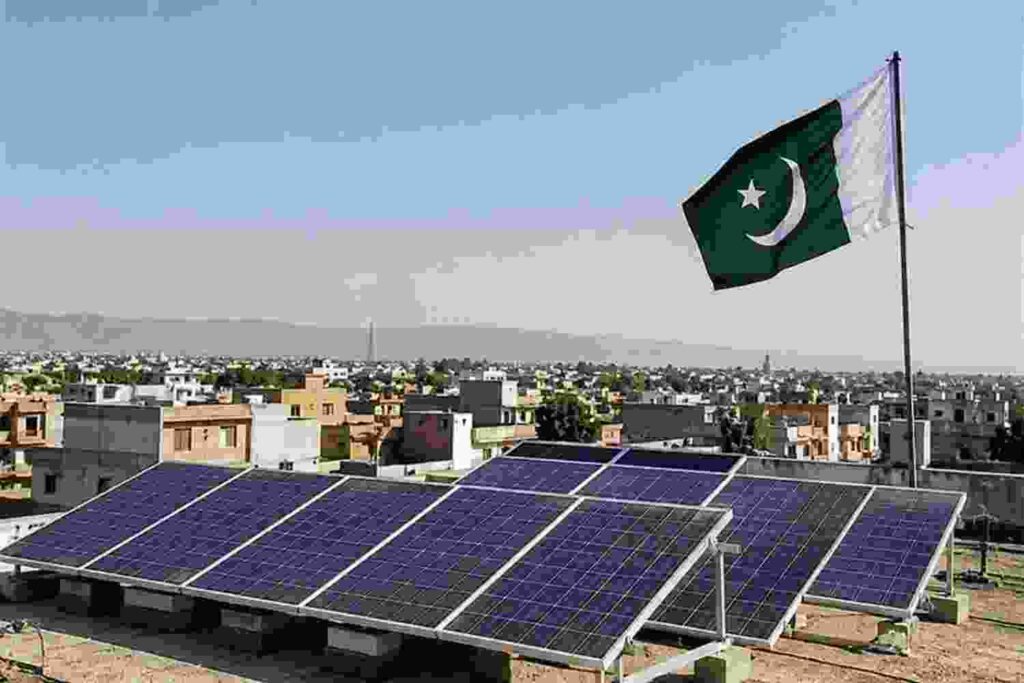
Introduction: The Country That Surprised the World
Nobody predicted this.
Solar Energy analysts, policy experts, international institutions — none of them forecast that Pakistan, a country battling circular debt, power outages, and one of the world’s most stressed electricity grids, would become one of the fastest solar-adopting nations on Earth.
But that is exactly what happened.
<cite index=”18-1″>As of 2025, solar power is the largest electricity source in Pakistan, accounting for more than 25% of total production.</cite> That number — one in every four units of electricity from the sun — represents one of the most dramatic energy transformations any developing country has achieved in modern history.
<cite index=”17-1″>By April 2025, rooftop solar installations had surged to 2.8 GW in just the first 10 months of the fiscal year 2024–25, bringing the cumulative national total to 5.3 GW — a nearly tenfold increase in just two years.</cite>
Pakistan imported more solar panels than any other country on Earth in 2024. The country that was running 12–18 hour load shedding schedules just a few years ago is now selling electricity back to the grid from rooftops in Lahore, Karachi, Peshawar, and thousands of towns and villages in between.
This is not a government success story, a donor-funded project, or a neatly planned policy achievement. It is something rarer and more powerful: a people-driven revolution, born out of frustration, enabled by technology, and now transforming the energy future of 240 million people.
This article tells the full story — how it happened, what it means, what the challenges are, and where Pakistan’s solar future is headed.
Part One: How Pakistan’s Solar Boom Happened
The Perfect Storm
<cite index=”22-1″>Electricity tariffs increased by 155% over three years, pushing energy costs beyond the reach of many. The withdrawal of government subsidies further raised prices for both industries and households.</cite>
When electricity becomes both unreliable and unaffordable simultaneously, people stop waiting for the government to solve the problem and solve it themselves. That is precisely what millions of Pakistani households, businesses, and factories did — and the scale of their response astonished the world.
<cite index=”16-1″>The driving forces were not government policy, but rather consumer desperation stemming from recurring and increasing circular debt, tariff hikes, and unreliable energy supply pushing households, businesses, and factories to generate their own electricity. Significantly, cheap Chinese solar panels, the prices of which had fallen fivefold between 2022 and 2024, made this transition economically viable.</cite>
Two forces collided at exactly the right moment: rising electricity prices and falling solar panel prices. Pakistani consumers did not need government encouragement to do the math. When solar panels became cheap enough that the upfront cost could be recovered in a few years of electricity bill savings, millions of people made the investment independently.
<cite index=”20-1″>Between 2019 and 2025, cumulative solar panel imports surpassed Pakistan’s total installed power plant capacity by 2 gigawatts. Yet only a fraction of this was utility-scale and connected to the grid — suggesting a paradigm shift in the country’s power sector, with rapid growth of small solar PV systems.</cite>
The Numbers That Tell the Story
The scale of Pakistan’s solar adoption is genuinely staggering:
- <cite index=”17-1″>Pakistan added 583 MW of net-metered rooftop solar capacity in 2022–23. In 2023–24, this more than doubled to 1,181 MW.</cite>
- <cite index=”16-1″>Net-metered rooftop capacity rose from under 1 GW in 2023 to approximately 4.9 GW by March 2025.</cite>
- <cite index=”17-1″>Pakistan’s rooftop solar boom is evident in its import data. Over the past four to five years, the country imported nearly 45 GW of solar panels — roughly equivalent to the total installed generation capacity of the national grid.</cite>
- <cite index=”18-1″>Pakistan imported 17 GW of solar panels in 2024 alone, making Pakistan one of the world’s largest importers of Chinese solar panels.</cite>
To put that last number in perspective: <cite index=”22-1″>by the end of 2024 alone, Pakistan imported 22 gigawatts’ worth of solar panels — more than Canada or the United Kingdom have installed in the last five years combined.</cite>
A country that most people associate with energy poverty was quietly becoming a global leader in solar adoption — driven not by wealthy institutions but by ordinary families making practical decisions about their own energy future.
The Net Metering Policy That Made It Possible
Behind the consumer revolution was a critical policy enabler. <cite index=”16-1″>The regulatory backbone for popular solar adoption was NEPRA’s 2015 net metering framework, which allowed consumers to offset electricity consumption with solar exports to the grid on a near 1:1 basis. The response was remarkable: peak period net-metered electricity exports more than doubled in 2025 alone.</cite>
Net metering — the system that allows solar panel owners to sell their excess electricity back to the grid at fair rates — turned solar from a one-way expense into a two-way financial relationship. Households that installed panels became small power producers, earning credits against their electricity bills that often reduced those bills to near zero.
This policy, combined with falling panel prices and rising grid electricity costs, created a mathematical incentive so powerful that millions of Pakistanis acted on it without being asked, subsidized, or organized.
Part Two: Where Pakistan Stands Today
Solar as the Dominant Source
The headline number — <cite index=”23-1″>solar power accounted for more than 25 percent of utility-supplied electricity in early 2025, making Pakistan one of a small number of countries globally where solar has achieved such a high share of utility generation</cite> — understates the actual scale because it captures only grid-connected solar.
<cite index=”17-1″>A large number of installations remain off-grid and are not captured in official net-metering statistics.</cite> When off-grid rooftop systems, agricultural solar pumps, commercial installations, and the vast array of small independent systems are included, Pakistan’s actual solar generation is significantly higher than official figures suggest.
Quaid-e-Azam Solar Park — Utility Scale Leadership
Beyond the rooftop revolution, Pakistan has invested in utility-scale solar generation. <cite index=”23-1″>Large utility-scale solar projects such as the Quaid-e-Azam Solar Park in Bahawalpur provide further evidence of long-term government engagement in utility solar generation.</cite>
The Quaid-e-Azam Solar Park — located in the Cholistan Desert in Punjab — is one of the largest solar installations in Asia, designed to generate clean electricity at grid scale. It represents the complementary strand of Pakistan’s solar story: while millions of households were independently going solar from the bottom up, the government was simultaneously building large centralized solar infrastructure from the top down.
Public Infrastructure Goes Solar
The solar revolution is not limited to private homes and businesses. <cite index=”23-1″>The federal government has begun transitioning 155 railway stations across Pakistan to solar power as a cost-reduction and modernization measure. This program is expected to save millions of rupees annually in operating costs while reducing load on the national grid. Solar energy has been deployed in thousands of schools across Pakistan to improve energy reliability and reduce electricity expenses. Programs supported by the Asian Development Bank (ADB) and the government have installed solar facilities in public schools, expanding access to electricity for essential services.</cite>
This public sector dimension of the solar transformation is especially significant for Pakistan’s development goals. Schools that previously had no reliable electricity — or spent large portions of their operating budgets on diesel generators — now have clean, consistent, low-cost power that enables better learning environments, digital tools, and year-round operation of fans and cooling systems in Pakistan’s intense heat.
The Google Factor — Chromebook Manufacturing and the Digital Economy
Pakistan’s solar future is also connecting to its broader economic transformation. As covered extensively in Factsnest’s article on Google’s expansion in Pakistan, the newly opened Google office in Islamabad (August 2026) and the Chromebook assembly line in Haripur represent exactly the kind of technology-intensive industry that requires reliable, affordable energy — the kind that solar increasingly provides.
A stable, solar-powered energy supply is not just a household amenity. It is infrastructure for the digital economy, the manufacturing sector, and the $30 billion IT export ambition that Pakistan’s government has set as its central economic goal.
Part Three: The Economic Case for Solar in Pakistan
What Solar Means for Household Finances
For the millions of Pakistani families who have installed solar panels, the financial impact is immediate and dramatic. A household that previously paid Rs. 25,000–40,000 per month in electricity bills during summer months can reduce that bill to near zero — or even earn credits — from a system that pays for itself in 3–5 years at current panel prices and electricity rates.
<cite index=”24-1″>This radical shift reduces the nation’s reliance on imported fossil fuels, thereby decreasing the burden on foreign exchange reserves.</cite>
The foreign exchange dimension is critically important for Pakistan’s macroeconomic health. Pakistan imports virtually all of its fossil fuel requirements — oil for power generation, transport, and industry — spending billions of dollars annually that drain the country’s foreign exchange reserves and contribute to the chronic balance of payments pressures that have repeatedly pushed Pakistan toward financial crisis.
Every unit of solar electricity generated domestically is a unit of electricity that does not require imported fuel. At the scale Pakistan has now reached — 25% of electricity from solar — this represents a genuinely significant reduction in the country’s fossil fuel import bill.
The Investment Numbers
<cite index=”24-1″>The government has played a pivotal role in facilitating this solar boom by introducing policies and incentives that encourage investment in renewable energy. Measures like tax exemptions, subsidies, and streamlined approval processes have created a fertile ground for growth. This supportive environment has attracted significant investment, evidenced by the US$4.1 billion spent on importing solar panels over the last four years.</cite>
$4.1 billion in solar panel imports represents a massive private sector investment in Pakistan’s energy infrastructure — investment made not by international donors or government programs but by Pakistani businesses, institutions, and households acting in their own rational financial interest.
Jobs and Industry
Pakistan’s solar boom has created a substantial new industry around installation, maintenance, sales, and distribution of solar equipment. Solar installers, electricians trained in solar systems, panel distributors, battery suppliers, and inverter technicians represent a growing segment of Pakistan’s informal and formal workforce.
<cite index=”19-1″>Battery imports are projected to reach 8.75 GWh by 2030, driven by surging residential, commercial, and off-grid energy demand.</cite> This growing battery storage market represents a further wave of economic activity — installation jobs, import businesses, and increasingly, the possibility of domestic manufacturing.
Pakistan’s first Chromebook assembly line at the NRTC facility in Haripur represents a model for what could happen in solar hardware manufacturing — if Pakistan can move from being a pure importer of Chinese solar panels to being a value-adding manufacturer or assembler in the solar supply chain, the economic benefit multiplies substantially.
Part Four: The Challenges Pakistan Must Overcome
The Grid Stability Crisis
Pakistan’s solar boom has been remarkable — but it has also created a serious structural challenge for the national electricity grid, and understanding this challenge is essential for understanding what the solar future actually looks like.
<cite index=”22-1″>Between 2019 and 2025, only a small share of installed solar capacity — 0.7 GW — was utility-scale and connected to the national grid. This indicates rapid but uncoordinated distributed growth, with insufficient system-level planning or integration. Such fragmentation poses long-term challenges for the grid’s stability and financial health.</cite>
The problem is this: when millions of households install solar panels and either go partially or fully off-grid, the utility companies (DISCOs — Distribution Companies) lose a large portion of their paying customers. But the fixed costs of maintaining the grid — the power plants, the transmission lines, the distribution infrastructure — do not disappear. These costs are spread over a shrinking customer base, which means electricity prices for those who remain on the grid rise further — which pushes more people toward solar — which reduces the customer base further — which raises prices again.
This is called the utility death spiral, and it is a genuine threat to Pakistan’s electricity infrastructure if not managed carefully.
<cite index=”22-1″>As wealthier consumers defect from the grid, utilities face a collapse in revenue, while still bearing the fixed costs of generation and transmission. These costs will likely be passed on to the remaining grid-dependent customers.</cite>
The households that can afford solar panels are, overwhelmingly, the middle and upper classes. The households that cannot afford solar — the poorest Pakistani families — are the ones left on the grid, now facing even higher electricity prices as utility revenues fall.
The New Net Metering Regulations — 2026
<cite index=”16-1″>In February 2026, Pakistan’s National Electric Power Regulatory Authority (NEPRA) issued new Prosumer Regulations 2026, effectively ending the older unit-for-unit net metering model for new installations.</cite>
These new regulations — which reduce the rate at which solar panel owners are compensated for electricity they export to the grid — are deeply controversial. The solar industry and consumer advocates argue that they undermine the financial case for new solar installations. The government and utilities argue that the old net metering model was financially unsustainable and was being subsidized by non-solar customers.
<cite index=”19-1″>The future net metering policy is highly likely to be adjusted to favor pure PV. Therefore, from 2026 onwards, PV plus energy storage (PVS) is the inevitable choice to ensure nighttime electricity supply and completely eliminate high grid tariffs.</cite>
The net effect of the new regulations is that the optimal solar system design shifts: rather than relying on the grid as a virtual battery (exporting excess during the day, importing at night at equal credit), new solar adopters are increasingly incentivized to add battery storage — storing their own solar generation for use at night rather than exporting it.
This is actually a more energy-independent model — and better for grid stability — but it raises the upfront cost of solar installation significantly.
The Coal Contradiction
Pakistan’s solar story has a troubling shadow: <cite index=”21-1″>Pakistan has not committed to phasing out coal power plants. None of the country’s operational coal-fired plants currently has a scheduled retirement timeline, and coal exit targets are not included in Pakistan’s Nationally Determined Contributions (NDCs) under its climate commitments.</cite>
<cite index=”25-1″>Pakistan’s electricity generation is still heavily reliant on thermal power plants, with a projected share of 57.3% in 2024 and 56.7% in 2025. Coal-fired power plants are expected to contribute 25.4% of total electricity generation in 2025.</cite>
This is the central contradiction of Pakistan’s energy transition: a country that has achieved remarkable solar penetration from the bottom up continues to build and operate coal power plants at the top down. The solar revolution represents genuine progress — but it coexists with carbon infrastructure whose long-term climate and economic costs are substantial.
For Pakistan to genuinely realize its solar potential, the transition away from fossil fuel-based generation must accelerate on the utility scale — not just the rooftop scale.
The Equity Problem — Solar for the Rich Only?
Perhaps the most socially important challenge in Pakistan’s solar future is equity. The families who have benefited most from the solar boom are, almost by definition, those with the capital to invest upfront — the middle and upper classes with the financial resources to purchase and install solar systems.
The rural poor, the urban slum dweller, the family living in a rented home who cannot install panels on a landlord’s roof — these are the people who remain dependent on an increasingly expensive and unreliable grid, paying higher and higher prices as wealthier consumers exit the system.
Solving this equity problem — through innovative financing models, community solar schemes, government subsidy programs targeted at low-income households, and rural electrification through off-grid solar — is the defining social challenge of Pakistan’s energy transition.
Part Five: The Road Ahead — Pakistan’s Solar Future
What 2030 Could Look Like
<cite index=”19-1″>PV installations exceeded 5.3 GW in 2025. Battery imports are projected to reach 8.75 GWh by 2030, driven by surging residential, commercial, and off-grid energy demand.</cite>
The trajectory of Pakistan’s solar expansion, if sustained, points toward a genuinely transformative energy landscape by 2030:
Solar as the dominant electricity source. At the current rate of expansion, solar could supply 40–50% of Pakistan’s total electricity by 2030 — making it unambiguously the country’s largest single source of power.
Battery storage becoming standard. As the new net metering regulations redirect incentives toward storage, and as battery prices continue to fall, the typical solar installation will increasingly include battery backup — making Pakistani homes and businesses genuinely energy independent for most of their daily needs.
Agricultural transformation. Pakistan’s agriculture sector, which consumes enormous quantities of diesel fuel for irrigation pumps, is already experiencing rapid solar adoption. Solar-powered irrigation reduces input costs for farmers, improves the economics of food production, and reduces a major source of diesel import demand.
Industrial competitiveness. Pakistani factories and manufacturing units with solar installations gain a competitive cost advantage over those still relying on expensive grid electricity. As more industrial users go solar, Pakistan’s manufacturing sector becomes more cost-competitive in international markets.
The Battery Storage Revolution Coming Next
<cite index=”19-1″>From 2026 onwards, PV plus energy storage (PVS) is the inevitable choice to ensure nighttime electricity supply and completely eliminate high grid tariffs.</cite>
Battery storage is the next frontier of Pakistan’s solar transition — and the economics are moving rapidly in its favor. As global battery prices continue to fall (they have fallen approximately 90% over the past decade), adding battery storage to solar systems becomes financially viable for a growing segment of Pakistani households and businesses.
A home with solar panels and adequate battery storage can, on most days, operate completely independently of the grid — generating electricity during the day, storing excess, and using that stored electricity at night and during cloudy periods. For a country with Pakistan’s grid reliability challenges, this level of energy independence is extraordinarily attractive.
Domestic Manufacturing — The Next Opportunity
Pakistan currently imports virtually all of its solar panels — predominantly from China. The economic value added in Pakistan from the solar boom is primarily in installation, distribution, and maintenance — not in manufacturing.
The most significant economic opportunity in Pakistan’s solar future is the development of domestic solar manufacturing capability — either solar panel assembly, battery manufacturing, or component production. The NRTC Chromebook assembly partnership with Google in Haripur demonstrates that Pakistani manufacturing capability can be developed in partnership with international technology companies.
A similar model — international solar or battery manufacturer partnering with Pakistani public or private sector to establish assembly operations — could transform Pakistan from a pure importer of solar hardware into a value-adding participant in the global solar supply chain.
Renewable Energy Targets and Policy Direction
Pakistan’s government has set ambitious renewable energy targets — aiming for 60% renewable electricity by 2030. <cite index=”24-1″>Projections indicate that solar, which accounted for less than 1% of grid capacity in 2023, could supply as much as 20% of the country’s electricity by 2026 — a radical shift that reduces the nation’s reliance on imported fossil fuels.</cite>
Reaching the 60% renewable target by 2030 will require not just continued rooftop adoption but a major expansion of utility-scale solar and wind, significant investment in grid modernization and storage, and the gradual retirement of fossil fuel generation capacity.
The policy environment in 2026 is complex: the new NEPRA net metering regulations have slowed rooftop solar economics for some consumers while the government simultaneously pursues large-scale renewable projects. Getting the policy balance right — maintaining incentives for distributed solar while managing grid stability and equity concerns — will determine how quickly Pakistan reaches its renewable energy potential.
Part Six: What Solar Energy Means for Pakistan’s Future
Energy Independence From Fossil Fuels
Pakistan’s greatest economic vulnerability has long been its dependence on imported fossil fuels. Oil and gas imports consume billions of dollars in foreign exchange annually, contribute to chronic balance of payments deficits, and expose the Pakistani economy to the volatility of global commodity prices.
Solar energy is different in its economic structure: the fuel — sunlight — is free, abundant, and domestically available. The upfront investment in panels and installation, once made, produces electricity for 25+ years at near-zero marginal cost.
At the scale Pakistan has now reached, solar is already making a meaningful contribution to reducing fossil fuel import demand. At the scale Pakistan could reach by 2030, it could transform the country’s energy economics entirely — freeing billions of dollars in foreign exchange currently spent on fuel imports for investment in education, health, infrastructure, and economic development.
Climate Commitment
Pakistan is one of the world’s most climate-vulnerable countries — despite being responsible for less than 1% of global carbon emissions. Floods, droughts, glacial melting in the north, and intense heat waves are already causing enormous human and economic damage.
The transition to solar energy represents Pakistan’s most significant practical contribution to climate mitigation while simultaneously addressing its own energy security and economic development needs. Unlike many climate solutions that require sacrifice or cost, Pakistan’s solar boom is being driven by financial self-interest — which makes it far more durable and scalable than policy-driven programs that depend on continued political will.
A Model for the Developing World
Pakistan’s solar story carries lessons for dozens of other developing countries facing similar challenges: expensive and unreliable electricity, high fossil fuel import costs, and large populations with unmet energy needs.
The Pakistani model — consumer-driven solar adoption, enabled by falling prices and supportive (if imperfect) net metering policy — demonstrates that developing countries do not need to wait for massive government programs, international financing, or technological perfection to begin a meaningful energy transition.
When the economics align and the technology is accessible, ordinary people will make the transition themselves.
What You Can Do — Practical Steps for Pakistanis
For Homeowners
If you have not yet explored solar for your home, 2026 is still a strong time to act — despite the new net metering regulations. The economics of solar-plus-storage are compelling, and the upfront cost of panels continues to fall.
Steps to take:
- Get your last 12 months of electricity bills and calculate your average monthly consumption in units (kWh)
- Get at least three quotes from AEDB-registered solar installers (the Alternative Energy Development Board maintains a registry of authorized installers)
- Ask each installer to quote both a grid-tied system and a solar-plus-battery system, so you can compare the economics of both
- Check whether your distribution company (DISCO) is processing net metering applications and what the current compensation rate is
- Explore financing options — several Pakistani banks now offer solar financing products with competitive rates
For Businesses
For Pakistani businesses — particularly those with high daytime electricity consumption such as factories, commercial centers, hospitals, and educational institutions — solar is one of the highest-return investments available. Businesses with flat, unshaded rooftops and high daytime electricity usage typically achieve payback periods of 3–4 years.
For Farmers
Agricultural solar — solar-powered tube well pumps — is one of the highest-impact applications of solar in Pakistan’s specific context. If you operate agricultural land with diesel-powered irrigation, exploring solar pump conversion can dramatically reduce input costs and improve the profitability of farming operations.
Conclusion: The Revolution Has Already Begun — The Question Is What Comes Next
When historians look back at Pakistan’s energy story in the early 21st century, they will note an extraordinary thing: the country’s most significant energy transformation was not planned by any government, financed by any international institution, or driven by any single policy. It was driven by millions of ordinary Pakistani families making practical decisions about how to power their homes and businesses.
<cite index=”16-1″>Pakistan’s adoption of solar has been the fastest of any country of its size.</cite>
That achievement belongs to the Pakistani people. To the shopkeeper in Lahore who installed panels on his shop roof to escape load shedding. To the farmer in Punjab who switched his tube well to solar to escape diesel costs. To the family in Karachi that borrowed money to install a rooftop system and watched their electricity bill fall to near zero.
The challenges ahead are real: grid stability, the equity gap, the coal contradiction, and the policy uncertainty created by changing net metering rules. These are not minor complications — they will determine whether Pakistan’s solar revolution delivers on its full transformative potential or stalls at a level of impressive but incomplete achievement.
But the foundation has been laid. <cite index=”23-1″>Solar power accounted for more than 25 percent of utility-supplied electricity in early 2025, making Pakistan one of a small number of countries globally where solar has achieved such a high share of utility generation.</cite>
A country that was importing fossil fuels and suffering through load shedding is now generating a quarter of its electricity from sunlight — free, clean, and domestically available in abundance.
The sun rises over Pakistan every morning with energy sufficient to power a nation many times its size. The Pakistani people have already begun to capture that energy. The future belongs to those who finish the job.