
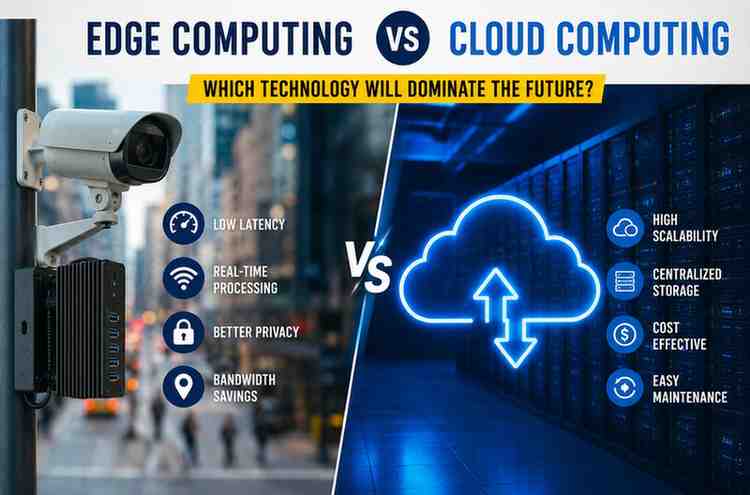
introduction
The digital international is producing greater facts than ever before. From smart gadgets and self sufficient vehicles to online streaming and synthetic intelligence, contemporary technologies depend on rapid and green facts processing. As businesses and consumers demand better overall performance, two computing models have come to be critical to the conversation: facet computing and cloud computing.
For years, cloud computing has converted how companies save, control, and method records. but, the speedy growth of linked gadgets and real-time applications has created new challenges. This has caused the upward thrust of side computing, a generation designed to procedure records in the direction of in which it’s far generated.
The query many generation experts and commercial enterprise leaders are asking is straightforward: Which generation will dominate the future—edge computing or cloud computing?
the answer is greater complicated than deciding on a single winner. both technologies offer specific blessings, and expertise their strengths can assist businesses make smarter decisions in a hastily evolving digital landscape.
knowledge Cloud Computing
Cloud computing refers back to the transport of computing offerings over the internet. in preference to storing records or going for walks packages on nearby computer systems, organizations use faraway servers controlled via cloud providers.
How Cloud Computing Works
while users get admission to cloud-based totally applications, their facts is sent to centralized facts facilities. those centers comprise effective servers able to handling huge amounts of records.
Cloud offerings typically include:
- data storage
- software applications
- Database control
- device studying gear
- Computing power
- Backup and catastrophe restoration
famous cloud systems provide organizations with scalable assets that can extend or reduce consistent with demand.
advantages of Cloud Computing
1. Scalability
businesses can fast increase or lower resources without shopping extra hardware.
2. fee performance
businesses keep away from huge upfront investments in infrastructure and pay simplest for the services they use.
3. Accessibility
Cloud-based totally structures can be accessed from anywhere with a web connection.
4. Centralized control
IT teams can manipulate applications, security, and updates from a unmarried area.
5. records Backup and restoration
Cloud carriers often provide advanced backup answers that reduce the risk of information loss.
actual-world example
A international streaming platform serves hundreds of thousands of customers simultaneously. Cloud infrastructure permits it to deal with sudden spikes in visitors at some point of main occasions without shopping extra physical servers.
what is area Computing?
edge computing is a disbursed computing version that strategies facts near its source instead of sending everything to cloud server.
in preference to shifting all facts to centralized statistics facilities, part devices perform nearby processing and evaluation.
How aspect Computing Works
side computing locations computing assets closer to users and devices.
Examples include:
- clever sensors
- business machines
- safety cameras
- self sustaining cars
- smart home gadgets
- local edge servers
those systems examine data immediately and most effective ship important information to the cloud.
benefits of edge Computing
1. decreased Latency
records is processed closer to in which it is created, resulting in faster reaction instances.
2. decrease Bandwidth utilization
less statistics travels throughout networks, lowering congestion and communique prices.
3. improved Reliability
devices can retain running even if net connectivity becomes volatile.
4. enhanced protection
sensitive facts can continue to be nearby instead of being transmitted across more than one networks.
five. higher actual-Time overall performance
packages requiring instant choices benefit appreciably from part processing.
actual-world example
An self sufficient automobile cannot wait several seconds for instructions from a distant server. It have to procedure road conditions, barriers, and visitors information right away. facet computing enables those actual-time selections.
Key variations between facet Computing and Cloud Computing
even though each technologies process and manage statistics, their strategies fluctuate considerably.
| feature | Cloud Computing | facet Computing |
|---|---|---|
| records Processing | Centralized facts facilities | near the statistics supply |
| Latency | better | Very low |
| Scalability | extraordinarily excessive | mild |
| net Dependency | excessive | lower |
| actual-Time performance | restrained for crucial duties | wonderful |
| Infrastructure value | lower in advance costs | higher deployment costs |
| Bandwidth utilization | higher | lower |
| information garage | Centralized | distributed |
knowledge these differences enables businesses determine which answer best suits their operational necessities.
Why Cloud Computing became So popular
Cloud computing revolutionized the era industry because it solved essential demanding situations related to traditional IT infrastructure.
bendy aid management
agencies not had to buy expensive servers that might take a seat unused at some point of low-call for intervals.
worldwide attain
Cloud carriers perform facts centers round the sector, permitting corporations to serve clients across more than one areas.
aid for Innovation
Cloud platforms provide improved offerings along with:
- artificial intelligence
- huge statistics analytics
- software improvement tools
- Cybersecurity solutions
This lets in organizations to innovate quicker without constructing complex infrastructure themselves.
far flung paintings Enablement
The upward push of far off and hybrid work models accelerated cloud adoption by using presenting personnel with cozy get right of entry to to applications from any vicinity.
Why part Computing Is developing unexpectedly
The explosive growth of related gadgets has created new demands that cloud computing on my own can not usually meet.
The net of things (IoT) Revolution
Billions of IoT gadgets generate giant volumes of statistics each 2nd.
Examples include:
- smart factories
- clever cities
- Wearable devices
- connected healthcare device
Sending all this information to remote cloud servers can create delays and increase charges.
call for for real-Time programs
Many cutting-edge packages require instant responses.
Examples include:
- Self-riding automobiles
- industrial automation
- Augmented truth
- virtual truth
- smart site visitors systems
Even small delays can have an effect on overall performance or safety.
network performance
edge computing reduces the quantity of facts transmitted throughout networks via filtering and processing records domestically.
This helps groups reduce bandwidth charges while improving performance.
Industries Being converted through aspect Computing
Healthcare
Hospitals more and more use related scientific devices to screen patients in actual time.
edge computing permits:
- faster diagnostics
- on the spot alerts
- reduced community dependence
- better affected person effects
manufacturing
clever factories depend on sensors and automatic device.
side computing facilitates producers:
- detect system disasters right away
- improve best manipulate
- reduce downtime
- increase productiveness
Transportation
connected cars generate huge amounts of data each 2nd.
edge systems assist:
- Collision avoidance
- Navigation assistance
- Fleet monitoring
- traffic optimization
Retail
shops use facet technology for:
- clever checkout systems
- stock monitoring
- personalized customer stories
- protection monitoring
challenges of Cloud Computing
notwithstanding its advantages, cloud computing faces several barriers.
Latency troubles
facts have to journey to centralized servers and again, which can create delays.
community Dependency
Cloud services rely closely on strong net connections.
statistics transfer prices
massive volumes of facts can increase bandwidth costs.
privateness worries
groups managing sensitive facts might also decide on local processing to satisfy compliance requirements.
challenges of area Computing
side computing additionally presents precise challenges.
complicated Infrastructure
handling hundreds of distributed gadgets can be difficult.
protection dangers
extra related endpoints create extra opportunities for cyberattacks.
higher initial fees
Deploying facet hardware regularly requires tremendous funding.
renovation necessities
corporations have to monitor and replace numerous gadgets across a couple of locations.
The role of artificial Intelligence
artificial intelligence is accelerating the growth of both cloud and side computing.
AI within the Cloud
Cloud systems provide:
- large-scale AI version training
- massive facts garage
- superior analytics
- high-overall performance computing
AI at the threshold
side AI permits gadgets to make wise selections without counting on distant servers.
Examples encompass:
- Facial recognition systems
- clever surveillance cameras
- industrial robots
- Voice assistants
As AI will become greater common, companies more and more integrate cloud and aspect technologies to maximise overall performance.
Will side Computing update Cloud Computing?
Many people expect facet computing will subsequently update cloud computing, but that is not going.
the 2 technologies clear up one of a kind troubles.
Cloud computing excels at:
- large-scale garage
- lengthy-term analytics
- Centralized control
- global accessibility
part computing excels at:
- real-time processing
- Low-latency applications
- local decision-making
- Bandwidth optimization
in preference to replacing one another, they complement every other.
as an example, a clever manufacturing facility can also use part devices to screen equipment in real time at the same time as sending summarized statistics to the cloud for lengthy-term evaluation and reporting.
The destiny: Hybrid Computing fashions
The most likely destiny is not edge as opposed to cloud—it’s miles part plus cloud.
How Hybrid fashions work
In a hybrid structure:
- records is generated at the edge.
- immediate processing occurs locally.
- critical information is despatched to the cloud.
- The cloud performs deeper evaluation and storage.
- Insights are returned to part devices.
This method combines the strengths of both technology.
benefits of Hybrid Computing
- quicker reaction instances
- better scalability
- progressed security
- reduced bandwidth utilization
- extra reliability
- more advantageous user experiences
Many technology experts agree with hybrid computing becomes the standard structure for destiny digital systems.
future developments Shaping the opposition
1. enlargement of 5G Networks
faster mobile networks will reinforce part computing by way of permitting rapid verbal exchange among gadgets.
2. boom of smart cities
urban infrastructure will increasingly more rely upon aspect-powered systems for traffic management, public protection, and electricity optimization.
three. extra connected gadgets
The number of IoT devices keeps to develop, growing call for for local processing.
four. superior artificial Intelligence
AI programs will require both part and cloud sources to function correctly.
5. more potent Cybersecurity solutions
New security technology will make distributed part environments greater dependable and cozy.
6. industry-precise part structures
customized area answers will emerge for healthcare, manufacturing, retail, and transportation sectors.
Which generation Will Dominate the destiny?
The future is not going to be ruled by a unmarried technology.
Cloud computing will stay vital as it gives unmatched scalability, storage capability, and centralized control. on the identical time, edge computing will continue expanding due to the fact current packages increasingly require actual-time processing and low latency.
in place of competing immediately, these technology will paintings collectively to create smarter, faster, and more green digital ecosystems.
businesses that successfully combine cloud and side computing will advantage the finest blessings in performance, innovation, and client revel in.
conclusion
the talk among edge computing and cloud computing is frequently framed as a battle for technological dominance. In truth, both technology serve critical however specific functions.
Cloud computing remains the backbone of modern virtual infrastructure, providing scalable resources, centralized garage, and effective analytical abilties. area computing addresses the growing want for velocity, responsiveness, and local selection-making in a world full of connected devices.
As technology such as artificial intelligence, IoT, self sustaining systems, and 5G continue to adapt, the destiny will belong to companies that leverage each approaches correctly. in preference to deciding on one over the alternative, businesses ought to cognizance on building hybrid environments that combine the strengths of cloud and side computing.
The future of computing isn’t approximately replacing the cloud with the threshold—it’s far about creating a unbroken partnership between the two.
often requested Questions (FAQ)
1. what is the primary difference between part computing and cloud computing?
Cloud computing techniques facts in centralized information centers, while area computing techniques records toward wherein it’s far generated.
2. Is side computing quicker than cloud computing?
sure. part computing normally provides lower latency because statistics travels a far shorter distance.
3. Can part computing work with out the cloud?
aspect computing can carry out many duties independently, however maximum agencies nevertheless use cloud services for storage, analytics, and centralized control.
4. Which industries gain most from aspect computing?
Healthcare, manufacturing, transportation, retail, telecommunications, and clever town tasks benefit significant benefits from edge computing.
5. Will aspect computing update cloud computing within the future?
No. maximum specialists anticipate a hybrid version where part and cloud computing paintings together to deliver the exceptional overall performance and efficiency.