
Introduction
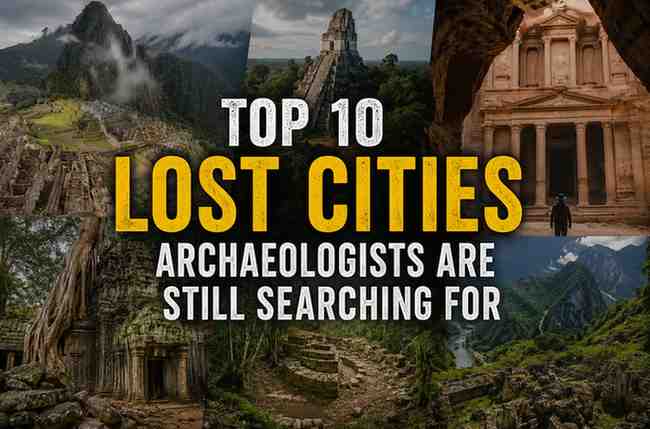
Throughout history, entire cities have vanished without warning. Some were swallowed by deserts, buried under jungles, destroyed by disasters, or simply abandoned over time. Yet many of these places continue to live in legends, ancient texts, and local stories. For archaeologists, lost cities are more than myths—they are clues to forgotten civilizations and human history.
Modern technology has helped researchers uncover famous places like Machu Picchu and Troy, but many legendary cities remain hidden. Satellites, ground-penetrating radar, and underwater exploration have improved the search, yet some mysteries still refuse to be solved.
From the golden city of El Dorado to the lost kingdom beneath the sands of Arabia, these missing locations continue to capture global attention. Some may already exist beneath our feet, waiting to be uncovered.
Here are the top 10 lost cities archaeologists are still searching for and why they remain some of the greatest mysteries in history.
1. Atlantis – The Legendary Sunken Civilization
The Story Behind Atlantis
Atlantis is perhaps the most famous lost city in the world. The ancient Greek philosopher Plato first described it around 360 BCE. According to his writings, Atlantis was a powerful island civilization that disappeared beneath the ocean after a catastrophic event.
Plato claimed Atlantis existed beyond the “Pillars of Hercules,” believed to mean the Strait of Gibraltar.
Why Archaeologists Still Search for It
Many experts believe Atlantis was fictional, created as a moral story. However, others think Plato may have based it on a real civilization destroyed by natural disasters.
Popular theories place Atlantis in:
- The Mediterranean Sea
- Near Santorini, Greece
- The Atlantic Ocean
- Antarctica
The eruption of Thera around 1600 BCE destroyed parts of the Minoan civilization, leading some researchers to connect it with the Atlantis legend.
Why It Matters
If Atlantis were real, it could reshape our understanding of ancient civilizations and maritime history.
2. El Dorado – The Golden City of South America
The Legend of Gold
El Dorado began as a story about a tribal chief covered in gold dust during ceremonies in present-day Colombia. Over time, European explorers transformed the tale into a mythical city filled with endless gold.
Spanish explorers spent centuries searching for it across South America.
Modern Search Efforts
Researchers now believe the legend may connect to ancient civilizations around Lake Guatavita or deep within the Amazon rainforest.
Recent discoveries using LiDAR scanning technology revealed hidden urban networks beneath jungle canopies, proving advanced societies existed there long ago.
Why It Fascinates Historians
The search for El Dorado shows how myths can drive exploration, conquest, and even historical tragedies.
3. The Lost City of Z – Brazil’s Jungle Mystery
A Dangerous Expedition
The Lost City of Z became famous after British explorer Percy Fawcett disappeared in the Amazon in 1925 while searching for it.
Fawcett believed an advanced ancient civilization once existed in the rainforest.
Evidence Supporting the Theory
For years, historians dismissed his ideas. However, recent discoveries have changed opinions.
Archaeologists uncovered:
- Massive earthworks
- Road systems
- Ancient settlements
- Agricultural networks
These findings suggest large societies lived in the Amazon before European contact.
Why It Remains Unsolved
The Amazon is one of the hardest places on Earth to explore. Dense forests still hide countless secrets beneath vegetation.
4. Petra’s Missing Areas – Jordan’s Hidden Secrets
More Than a Famous Tourist Site
Petra in Jordan is already known as one of the world’s greatest archaeological sites. Yet experts believe much of the ancient Nabataean city remains undiscovered.
Built into red sandstone cliffs, Petra was once a major trade center.
Hidden Structures Beneath the Sand
Satellite imagery and drone scans have revealed large buried structures near Petra that researchers are still investigating.
Possible discoveries include:
- Temples
- Markets
- Royal buildings
- Underground chambers
Why Archaeologists Continue Searching
Petra may still contain important clues about trade routes, water engineering, and desert survival in the ancient world.
5. The Lost City of Ubar – Atlantis of the Sands
A City Mentioned in Ancient Texts
Ubar, sometimes called the “Atlantis of the Sands,” was believed to be a wealthy trading city in the Arabian Peninsula.
Ancient stories describe it as a prosperous center connected to frankincense trade routes.
Discovery Attempts
In the 1990s, satellite images helped researchers locate ruins in Oman that may be linked to Ubar.
However, experts still debate whether the site is truly the legendary city or only part of a wider trading network.
Why the Mystery Continues
Shifting desert sands can bury entire settlements for thousands of years, making confirmation extremely difficult.
6. Thonis-Heracleion – Egypt’s Sunken Port City
A City Lost Underwater
For centuries, historians believed Thonis-Heracleion was only a legend. Ancient texts described it as a rich Egyptian port city that disappeared into the Mediterranean Sea.
In 2000, underwater archaeologists finally discovered its ruins near Alexandria.
Why the Search Is Not Over
Large sections of the city remain unexplored underwater.
Researchers continue finding:
- Giant statues
- Temples
- Coins
- Shipwrecks
Importance of the Discovery
The city provides valuable information about ancient Egyptian trade and Mediterranean culture.
It also proves that some “mythical” cities truly existed.
7. The White City – Honduras’ Jungle Legend
The City of the Monkey God
Legends from Honduras speak of a hidden city deep within the rainforest, sometimes called the White City or the City of the Monkey God.
Explorers searched for it for centuries but found little evidence.
New Technology Changes Everything
LiDAR scans recently revealed hidden structures beneath dense jungle vegetation.
Archaeologists discovered:
- Plazas
- Mounds
- Pyramids
- Ancient artifacts
Why It Is Still Mysterious
Researchers have only explored small sections of the area. Much remains buried and protected by thick rainforest.
8. Akakor – The Lost Underground City
Myth or Hoax?
Akakor supposedly existed in the Amazon and became famous after stories from a man claiming to know its hidden location.
The city was described as an underground civilization connected to ancient advanced technology.
Why Researchers Remain Interested
Although many claims surrounding Akakor were later questioned, some archaeologists still believe unknown settlements may exist in unexplored parts of the Amazon.
Lessons From the Story
Akakor highlights how myths, misinformation, and real archaeological possibilities can sometimes become mixed together.
9. Iram of the Pillars – The Desert Kingdom
Mentioned in Ancient Traditions
Iram, also known as Iram of the Pillars, appears in Arabian folklore and religious traditions as a magnificent city destroyed because of corruption and pride.
Some believe it was located in the Rub’ al Khali desert, also called the Empty Quarter.
Scientific Interest
Satellite studies have identified ancient caravan routes leading toward buried sites in the desert.
Researchers think these routes may connect to long-lost settlements.
Why It Captures Attention
The harsh desert environment preserves ruins well, but locating them remains a major challenge.
10. The Lost Capital of the Maya – Unknown Jungle Cities
Hidden Beneath Central America’s Forests
The Maya civilization built some of the most advanced cities in the ancient Americas. Yet archaeologists believe many major urban centers remain hidden beneath jungles in Guatemala, Mexico, and Belize.
Massive Discoveries in Recent Years
LiDAR technology transformed Maya archaeology by revealing:
- Thousands of hidden structures
- Elevated highways
- Defensive walls
- Agricultural systems
Some newly discovered areas may have housed millions of people.
Why the Search Continues
Large portions of Central American rainforest remain unexplored. New discoveries happen almost every year.
Why Lost Cities Matter Today
Lost cities are not just exciting mysteries. They help historians understand how civilizations lived, traded, adapted, and collapsed.
These discoveries can teach us about:
Climate Change and Survival
Many ancient cities disappeared due to droughts, floods, or environmental changes. Their stories may offer lessons for modern societies facing climate challenges today.
Human Innovation
Ancient engineers built complex roads, water systems, and architecture without modern technology.
Cultural Preservation
Finding lost cities protects endangered history from destruction, looting, and urban expansion.
Modern Technology Is Changing Archaeology
Archaeology today looks very different from the treasure hunts of the past.
New tools helping researchers include:
- LiDAR laser scanning
- Satellite imaging
- Underwater robotics
- DNA analysis
- Ground-penetrating radar
These technologies allow experts to locate buried ruins without damaging them.
In many cases, discoveries now happen from space before archaeologists even step onto a site.
The Challenges of Finding Lost Cities
Searching for lost cities remains extremely difficult.
Common obstacles include:
- Dense jungles
- Deep oceans
- Political instability
- Harsh deserts
- Limited funding
Some locations may never be found because natural disasters or erosion destroyed them completely.
Still, archaeologists continue searching because every discovery adds another piece to humanity’s story.
Conclusion
The world still holds countless secrets beneath oceans, forests, deserts, and mountains. Lost cities continue to fascinate people because they combine history, mystery, and adventure in a way few topics can match.
While some legendary places may remain myths forever, others are slowly emerging through science and technology. Discoveries in the Amazon, the Arabian desert, and underwater Egypt prove that ancient civilizations were often more advanced and connected than once believed.
As technology improves, archaeologists may eventually uncover cities that today exist only in stories and legends. Until then, the search for humanity’s forgotten worlds continues.
FAQ
1. What is the most famous lost city in history?
Atlantis is widely considered the most famous lost city because of its connection to ancient Greek stories and theories about a sunken civilization.
2. Have archaeologists really found lost cities?
Yes. Cities like Troy, Petra, and Thonis-Heracleion were once considered legendary before archaeologists confirmed their existence.
3. Why are many lost cities hidden in jungles?
Over time, forests can grow over abandoned settlements, completely covering roads, temples, and buildings.
4. What technology helps archaeologists find lost cities?
Modern archaeologists use LiDAR, satellite imaging, drones, underwater robots, and ground-penetrating radar.
5. Could there still be undiscovered ancient civilizations?
Yes. Experts believe many ancient settlements remain hidden, especially in remote jungles, deserts, and underwater regions.