
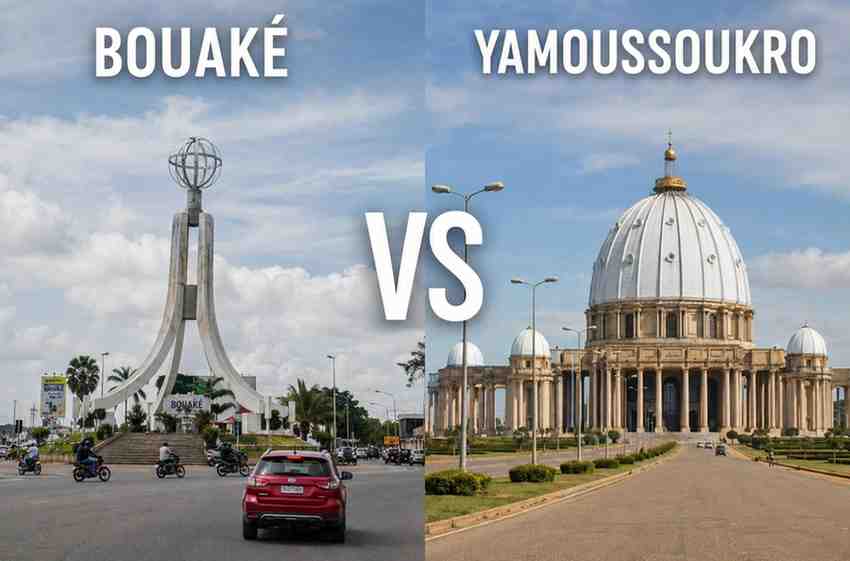
Introduction: Two Cities, One Country, Very Different Experiences
Côte d’Ivoire — known in English as Ivory Coast — is one of West Africa’s most dynamic and culturally rich countries. Most travelers land in Abidjan, the cosmopolitan economic capital on the Atlantic coast, and never venture much further inland. That is a genuine shame. Because two of the most fascinating cities in the country sit right in its geographic heart, waiting to be discovered.
Bouaké and Yamoussoukro — separated by just 110 kilometers and about 90 minutes of driving — could not feel more different from each other. One is gritty, loud, and bursting with commercial energy. The other is tranquil, spacious, and dominated by one of the most audacious architectural statements on the entire African continent.
Both are worth visiting. Both reward the curious traveler. But they will reward very different kinds of travelers — and choosing which one to prioritize, or how to divide your time between them, can make the difference between a good trip and an extraordinary one.
This guide gives you everything you need to choose wisely: a city-by-city breakdown of attractions, food, accommodation, safety, cost, transport, and the overall travel experience — followed by a straight-talking verdict on which city wins for each type of traveler.
Quick Overview: Know Your Cities Before You Go
Bouaké at a Glance
<cite index=”49-1″>Bouaké is a vibrant and culturally rich metropolis, serving as a vital crossroads in the heart of the nation. As the second-largest city in Ivory Coast, it pulses with an energy that blends traditional heritage with modern urban life. Located centrally in the Gbêkê region, approximately 350 kilometers north of Abidjan, the city acts as a major hub for commerce, transport, and education, connecting the southern coast with the northern savannahs.</cite>
<cite index=”49-1″>The city is historically significant as the center of the Baoulé people, one of the largest ethnic groups in the country, whose traditions deeply influence the local way of life.</cite>
With a population approaching 740,000, Bouaké is Côte d’Ivoire’s undisputed second city — a sprawling, commercial, people-filled place where trade, culture, and everyday West African life collide in spectacular fashion.
Yamoussoukro at a Glance
<cite index=”64-1″>Yamoussoukro, the political and administrative capital of Côte d’Ivoire, is a city of fascinating contrasts and grand ambitions. Located in the heart of the country, approximately 240 kilometres north of Abidjan, this relatively young capital (officially designated in 1983) was the birthplace of Côte d’Ivoire’s founding father, President Félix Houphouët-Boigny. With a population of around 300,000 residents, Yamoussoukro presents visitors with wide boulevards, grandiose architecture, and a surprisingly serene atmosphere that feels worlds apart from the bustling energy of the economic capital, Abidjan.</cite>
<cite index=”64-1″>The city is most famous for housing the magnificent Basilica of Our Lady of Peace, one of the largest churches in the world, which dominates the skyline with its Vatican-inspired dome rising majestically above the African landscape of coconut palms and savanna.</cite>
Where Bouaké is dense and energetic, Yamoussoukro is spacious and monumental — a capital city that was essentially built from scratch by presidential decree, and still carries the slightly surreal quality of a planned city that grew around a vision rather than a community.
The Attractions: What Will You Actually See?
Bouaké — The City That Immerses You
Bouaké is not a city of headline monuments. It does not have a single world-famous attraction that draws visitors from across the globe. What it has instead is something arguably more valuable for a certain kind of traveler: authentic urban West African life, playing out in all its complexity and color across a city that has been shaped by centuries of trade and cultural exchange.
The Grand Marché (Central Market) <cite index=”46-1″>The Marché Central de Bouaké is the beating heart of the city: a huge, chaotic market where you can buy fresh produce, West African textiles, Baoulé masks and beads, street food, and watch daily life up close.</cite> This is not a sanitized tourist market — it is a working commercial center where thousands of traders, farmers, and buyers conduct real business every single day. The sensory experience — the noise, the color, the smells of fresh spices and grilled meat and tropical fruit — is extraordinary.
The Dar Es Salam Dyers’ Quarter One of Bouaké’s most distinctive cultural experiences is the traditional indigo dyeing district, where craftspeople practice ancient fabric dyeing techniques that have been passed down through generations. Watching fabric transform from raw cotton into the deep blues and complex patterns of traditional West African textiles is a genuinely memorable experience — and the dyers are generally welcoming of curious visitors.
The Grand Mosque of Bouaké <cite index=”48-1″>The Bouaké Central Mosque features extraordinary architecture.</cite> One of the most impressive Islamic landmarks in central Côte d’Ivoire, the mosque is a striking structure that reflects the city’s significant Muslim population and the deep influence of Islamic culture on northern and central Ivorian life.
Cathédrale Saint-Michel <cite index=”49-1″>The Saint Michael’s Cathedral (Cathédrale Saint-Michel) stands as a prominent religious landmark with striking architecture that dominates the skyline.</cite> The coexistence of this Catholic cathedral and the Grand Mosque — both prominent, both actively used, both respected — speaks to something genuinely admirable about Bouaké’s religious pluralism.
La Tour des Télécommunications <cite index=”53-1″>For stunning views over Bouaké, visitors can climb the La Tour des Télécoms telecommunications tower just outside the city. At a height of 200 meters, this lookout spot lets you take in sprawling views of Bouaké and the surrounding landscape.</cite> Sunset is the recommended time to visit for spectacular golden-hour photography over the city.
The Pottery Village of Mangoro (Tanou Sakassou) About 20 kilometers outside Bouaké lies the pottery village of Tanou Sakassou, where <cite index=”55-1″>traditional pottery “mangoro” occupies an important place in the cultural and artistic heritage of Ivory Coast. The pottery is transmitted from generation to generation.</cite> Watching skilled potters work clay on traditional wheels using techniques essentially unchanged for centuries is a highlight of any visit to the Bouaké region.
Parc National de Marahoué (Day Trip) <cite index=”50-1″>Just a couple of hours from Bouaké lies Parc National de Marahoué, one of Côte d’Ivoire’s protected ecological treasures. This national park is home to forest elephants, monkeys, antelope, and over 300 species of birds, making it a must-visit for nature lovers and wildlife enthusiasts. Guided tours and birdwatching walks can be arranged with park officials or eco-tourism operators.</cite>
The N’Zi River Lodge (Day Trip) <cite index=”55-1″>Created in 2000, the N’Zi River Lodge is located 45 km northeast of Bouaké. The fauna and flora reserve park covers an area of 41,000 hectares composed of vast hilly landscapes created by rivers, plains, small wonderful mountains, a wooded savannah, several forests and rivers. The fauna is made up of several animal species including warthogs, buffaloes, kob, and duiker.</cite>
The Bouaké Carnival If your timing is right, Bouaké’s famous annual carnival — one of the most celebrated in West Africa — transforms the city into a festival of color, music, dance, and cultural performance. <cite index=”55-1″>The Bouaké Carnival is among the notable cultural festivals of the Bandama Valley region.</cite> It is the kind of event that travelers plan entire itineraries around.
Yamoussoukro — The City of Grand Statements
Yamoussoukro’s attraction list is shorter than Bouaké’s — but its headline attraction is arguably the single most spectacular sight in all of Côte d’Ivoire, and one of the most genuinely astonishing structures in all of West Africa.
The Basilica of Our Lady of Peace — The Crown Jewel of West Africa
<cite index=”72-1″>Imagine an architectural masterpiece officially recognized as the largest church in the world. The Basilica of Our Lady of Peace towers majestically over the city of Yamoussoukro. This grandiose structure was inspired by St. Peter’s Basilica in Rome but has surpassed it in physical size. The basilica’s total area reaches 30,000 square meters, with its dome soaring 158 meters into the sky. Within this colossal space, up to 18,000 worshippers can gather at once, enjoying the cool interior and the play of light through magnificent stained-glass windows.</cite>
<cite index=”78-1″>The Basilica of Our Lady of Peace erupts from the red earth of Yamoussoukro like a fever dream. You spot it miles across the savanna, a colossal dome of Italian marble and tinted French glass shimmering in West African heat, and disbelief is the honest reaction.</cite>
<cite index=”69-1″>The Basilica is built on 130 hectares according to the plans of architects Pierre Fakhoury (Lebanese-Ivorian) and Patrick d’Hauthuile (French). The building has 8,400 square meters of stained glass windows, one of which represents the face of Félix Houphouët-Boigny. Its appearance is reminiscent of St. Peter’s Basilica in Rome, but it exceeds the original by 17 meters and rises 158 meters above the surrounding vegetation.</cite>
No photograph truly prepares you for the experience of standing before this building. Its scale — in a country where most urban buildings are modest, on a continent where monumental architecture is typically ancient — is genuinely shocking. Whether you find it awe-inspiring, controversial, or some impossible combination of both, it will leave a lasting impression.
<cite index=”77-1″>A guided tour with certified guides is highly recommended, as it offers deeper insight into the monument’s history, architectural choices, and hidden symbols. The entrance fee is about 5,000 FCFA (around €7), and the guided visit usually lasts about 45 minutes.</cite>
The Presidential Palace and the Sacred Crocodile Lake
<cite index=”78-1″>Houphouët-Boigny’s official residence sits beside an artificial lake stocked with crocodiles, fed daily at around 5pm in a small ritual that has become a Yamoussoukro tradition. It pairs naturally with the basilica because both are products of the same vision of the city.</cite>
The daily crocodile feeding is one of Yamoussoukro’s most memorable experiences — the sacred crocodiles are real, large, and fed by attendants while visitors watch from a respectful distance. The ritual connection between the presidential family and the crocodiles is rooted in local tradition and mythology, giving the spectacle a cultural depth that goes beyond mere novelty.
Fondation Félix Houphouët-Boigny pour la Recherche de la Paix
<cite index=”64-1″>This institution honours the legacy of Côte d’Ivoire’s founding father.</cite> The Foundation is a grand congress center and museum complex with marble halls and exhibits tracing the political history of Côte d’Ivoire and the remarkable life of Houphouët-Boigny — the man who led the country from colonialism through independence and presided over one of post-colonial Africa’s most sustained periods of economic growth.
The Wide Boulevards and Grand Urban Scale
One of Yamoussoukro’s strangest and most memorable qualities is the sheer scale of its urban planning. <cite index=”64-1″>Yamoussoukro presents visitors with wide boulevards, grandiose architecture, and a surprisingly serene atmosphere.</cite> These boulevards — designed for a city of millions that never quite materialized — give Yamoussoukro an almost dreamlike quality. Eight-lane roads with barely any traffic. Grand roundabouts with nobody on them. A capital city with the bones of a metropolis and the pace of a country town.
For photographers and urban explorers, this quality is genuinely fascinating.
Abokouamekro Wildlife Reserve (Day Trip)
<cite index=”77-1″>Nearby nature reserves like Abokouamekro offer additional experiences for travelers interested in heritage and authentic Ivorian encounters.</cite> The reserve, located near Yamoussoukro, protects a variety of wildlife in a natural savanna setting and offers an accessible half-day excursion for visitors based in the city.
Food and Dining: Eating Your Way Through Both Cities
Bouaké — Street Food Heaven
Bouaké’s food scene is one of its greatest strengths for travelers willing to eat where locals eat. The city’s central location at the crossroads of Côte d’Ivoire’s major food-producing regions means fresh produce of extraordinary quality is always available.
Must-eat dishes in Bouaké:
- Attiéké — a dish of fermented cassava couscous, typically served with grilled fish (poisson braisé) and a fiery sauce. It is Côte d’Ivoire’s national comfort food and Bouaké’s street stalls serve it as well as anywhere in the country.
- Foutou — a hearty paste made from pounded plantain or yam, served with rich groundnut soup or palm nut soup. The dish of the Baoulé people, and deeply satisfying after a day of market exploration.
- Brochettes — grilled meat skewers sold by street vendors in the evenings, typically beef or chicken with spiced marinades. The smell alone will stop you in your tracks.
- Bangui — locally brewed palm wine, a gentle, slightly sweet fermented drink that is essential to social life in central Côte d’Ivoire.
<cite index=”46-1″>Bouaké’s open-air maquis bars hum with late-night conversation.</cite> The maquis — Côte d’Ivoire’s distinctive informal open-air restaurant/bar hybrid, typically operating from afternoon into the night — are where the city truly relaxes. Cold Bock or Flag beer, grilled fish, conversation with strangers, and the sound of Coupé-Décalé music drifting across warm evening air. This is the Bouaké dining experience at its best, and it is hard to replicate anywhere else.
Yamoussoukro — Quieter But Comfortable
Yamoussoukro’s restaurant scene is more limited than Bouaké’s simply because of the city’s smaller and less commercially intense population. However, the city has a solid range of dining options catering to government officials, visiting dignitaries, and the university community.
The maquis tradition is equally present here — look for open-air spots around the university district and along the main boulevard for good local food at fair prices. Traditional Ivorian dishes are well represented, and the relative quietness of the city makes the dining experience more relaxed than Bouaké’s sometimes overwhelming bustle.
The large hotels — particularly around the basilica area — offer more formal dining options at higher prices, which can be welcome after a long travel day.
Accommodation: Where Will You Sleep?
Bouaké — Budget to Mid-Range
Bouaké has the most varied accommodation options of the two cities, reflecting its larger size and commercial importance.
<cite index=”46-1″>Hostels in Bouaké are budget-friendly, often buzzing with fellow travelers eager to share stories and tips.</cite> For backpackers and budget travelers, the city offers genuine value — clean, inexpensive guesthouses and small hotels in the city center provide a comfortable base without straining finances.
<cite index=”48-1″>The Seen Ranhotel in Bouaké is a four-star establishment located in the heart of the city. Renovated in 2023, it is a charming, modern hotel with an elegant setting.</cite> This represents the upper end of Bouaké’s accommodation market — comfortable and well-situated, without reaching the luxury hotel price points of Abidjan.
Budget travelers: Expect to find decent rooms from approximately 8,000–15,000 FCFA per night. Mid-range travelers: Comfortable, air-conditioned rooms with reliable Wi-Fi in the 20,000–45,000 FCFA range. Upscale: The Seen Ranhotel and a small number of comparable properties offer four-star comfort at prices well below equivalent hotels in Abidjan.
Yamoussoukro — Mid-Range to Upscale
Yamoussoukro’s accommodation landscape reflects its nature as a political capital rather than a commercial hub. The city has fewer budget options than Bouaké but reasonably good mid-range and upscale choices — many of them originally built to accommodate government officials and international visitors.
The Hotel des Parlementaires is a well-known option, providing comfortable accommodation close to the main government institutions. Several guesthouses near the university district offer more affordable options for budget-conscious travelers.
The major caveat for Yamoussoukro accommodation is that booking in advance is strongly advisable, particularly if your visit coincides with any government or official events that fill the city’s limited hotel stock rapidly.
Budget travelers: Options are more limited; expect to pay slightly more for equivalent quality compared to Bouaké. Mid-range travelers: Solid options in the 25,000–55,000 FCFA range. Upscale: Embassy-standard hotels with international amenities exist but at premium prices.
Getting There: Transport Connections
Getting to Bouaké
Bouaké is very well connected by Ivorian standards. It has its own airport — Bouaké Airport (BYK) — with domestic connections. By road from Abidjan, the journey takes approximately 3.5–4 hours on the main A3 motorway, which is one of the better-maintained highways in the country. Multiple bus companies operate services from Abidjan’s Adjamé bus station.
The city also sits on the main north-south railway line — though rail services in Côte d’Ivoire are limited and not always reliable for tourist purposes. Bouaké’s central position makes it an ideal hub for exploring central Côte d’Ivoire, with connections north toward Korhogo and south toward Abidjan.
Getting to Yamoussoukro
<cite index=”77-1″>Yamoussoukro is located 110 km from Bouaké (about an hour and a half by car) and 331 km from Korhogo (around four hours by car). These distances place Yamoussoukro at the heart of Ivory Coast’s road network, making it a strategic gateway for exploring the country’s inland regions.</cite>
From Abidjan, <cite index=”72-1″>the journey by car or bus will take about 3–4 hours (the distance is approximately 240 kilometers). The roads between these key cities are well-maintained.</cite>
<cite index=”78-1″>Shared taxis and intercity buses run frequently from Abidjan’s Adjamé station and tend to be budget-friendly. Hiring a private driver for the day is a splurge but worth it if you want flexibility, since the basilica sits on the city’s outskirts and there’s no direct public transport to the gate.</cite>
Yamoussoukro also has an international airport — larger in design than its current traffic warrants, another legacy of Houphouët-Boigny’s grand vision for his hometown.
The Bouaké–Yamoussoukro Connection
One of the best aspects of visiting both cities is how easily they combine. At just 110 kilometers apart, the two cities can be visited on the same trip with ease. Many travelers use Yamoussoukro as a first stop from Abidjan (the basilica makes a dramatic introduction to inland Côte d’Ivoire), then continue north to Bouaké for a deeper immersion in commercial Ivorian life.
Alternatively, arrive in Bouaké first, spend 2–3 days exploring the city and its surroundings, then make the easy 90-minute journey to Yamoussoukro for a final day or two before returning to Abidjan.
Safety: What Travelers Need to Know
Both cities are significantly safer than they were during the period of political crisis and civil conflict that affected Côte d’Ivoire in the early 2000s. The country has been broadly stable since 2011, and the security situation in both Bouaké and Yamoussoukro has improved substantially.
Bouaké Safety
<cite index=”46-1″>While safety is generally decent, you’ll want to keep your wits about you after dark.</cite> As with any large African commercial city, standard urban safety precautions apply: avoid displaying expensive electronics or jewelry openly, be cautious in very crowded market areas where pickpocketing can occur, take registered taxis or use a trusted transport app rather than accepting rides from strangers, and avoid walking alone in unfamiliar areas late at night.
Bouaké’s density and commercial energy mean that situational awareness is always appropriate. However, travelers who exercise normal urban caution report generally positive safety experiences.
Yamoussoukro Safety
Yamoussoukro’s smaller size, lower density, and calmer atmosphere make it feel notably less threatening than Bouaké for many travelers. The wide streets and relatively sparse pedestrian traffic mean that potential hazards are easier to identify and avoid.
The main safety consideration specific to Yamoussoukro is respecting the zones around the Presidential Palace — unauthorized photography near security checkpoints is not recommended, and visitors should follow instructions from any security personnel they encounter near official buildings.
General Safety Tips for Both Cities
- Register with your country’s embassy or consulate before traveling to Côte d’Ivoire
- Purchase comprehensive travel insurance including medical evacuation
- Carry color copies of your passport and visa; keep originals secure
- The best time to visit both cities is during the dry season (November to March), when roads are better and outdoor exploration more pleasant
- Malaria prophylaxis is essential for travel to both cities
- Drink bottled or filtered water throughout your stay
Cost of Travel: How Does the Budget Compare?
Bouaké — Africa’s Excellent Value
Bouaké is genuinely excellent value for money by any standard. <cite index=”44-1″>Budget-conscious travelers may want to consider traveling to Bouaké between March and May, when hotel prices are generally the lowest.</cite>
Daily budget estimates (Bouaké):
- Backpacker/budget: 10,000–18,000 FCFA/day (accommodation + food + local transport)
- Mid-range: 30,000–60,000 FCFA/day
- Comfort: 70,000–120,000 FCFA/day
Street food in Bouaké is exceptionally cheap — a full plate of attiéké with grilled fish typically costs 500–1,500 FCFA. Local gbaka minibuses and shared taxis provide very affordable city transport.
Yamoussoukro — Slightly Higher, Still Reasonable
Yamoussoukro is marginally more expensive than Bouaké for accommodation — reflecting the limited supply of hotel rooms relative to demand from government and official visitors. However, food costs are comparable, and the main tourist attraction (the basilica) charges a very reasonable entrance fee.
<cite index=”77-1″>The entrance fee to the Basilica is about 5,000 FCFA (around €7), and the guided visit usually lasts about 45 minutes.</cite>
Daily budget estimates (Yamoussoukro):
- Backpacker/budget: 15,000–25,000 FCFA/day
- Mid-range: 40,000–75,000 FCFA/day
- Comfort: 80,000–140,000 FCFA/day
The Atmosphere: How Will Each City Make You Feel?
This is perhaps the most important distinction between the two cities — and the most personal.
Bouaké’s Atmosphere
<cite index=”46-1″>Bouaké’s vibe is gritty, energetic, and undeniably real.</cite> This is a city that does not perform for tourists — it simply exists, in all its chaotic commercial vitality. Walking through the Grand Marché, eating at a roadside maquis, watching the evening crowd gather at the city center — you feel genuinely immersed in Ivorian urban life rather than observing it from a distance.
<cite index=”47-1″>Bouaké offers a unique experience to travelers in search of authenticity. Plunge into the bustle of Bouaké’s central market, where colorful stalls overflow with fresh fruit, enchanting spices and local handicrafts.</cite>
For travelers who find genuine pleasure in the energy of a working African city — who prefer to eat where locals eat, watch what locals watch, and walk where locals walk — Bouaké delivers this in abundance.
Yamoussoukro’s Atmosphere
Yamoussoukro’s atmosphere is almost the photographic negative of Bouaké’s. Where Bouaké is dense and cacophonous, Yamoussoukro is spacious and hushed. Where Bouaké pulses with commercial urgency, Yamoussoukro moves at the deliberate pace of a government town.
The city has an almost surreal quality that grows on you: the basilica rising impossibly from the savanna, the grand boulevards stretching toward an empty horizon, the sacred crocodiles gliding silently in their presidential lake. Yamoussoukro feels like a city that was imagined by one extraordinary man and then left to become itself — slowly, on its own terms.
For travelers who seek contemplation over immersion, grandeur over bustle, and architectural wonder over street-level authenticity, Yamoussoukro is deeply compelling.
Head-to-Head Comparison: Category by Category
| Category | Bouaké | Yamoussoukro | Winner |
|---|---|---|---|
| Top Attraction | Grand Marché, Dar Es Salam dyers | Basilica of Our Lady of Peace | Yamoussoukro |
| Cultural Depth | Rich — Baoulé heritage, crafts, carnival | Deep — presidential legacy, UNESCO ambitions | Tie |
| Food Scene | Excellent — street food, maquis | Good — maquis, quieter dining | Bouaké |
| Accommodation Range | Budget to mid-range | Mid-range to upscale | Bouaké |
| Value for Money | Excellent | Good | Bouaké |
| Safety | Good (urban caution advised) | Very good (quieter, less crowded) | Yamoussoukro |
| Transport Links | Excellent — central hub | Good — well-connected | Bouaké |
| Atmosphere | Energetic, authentic, immersive | Serene, grandiose, contemplative | Depends on traveler |
| Nature/Day Trips | Marahoué NP, N’Zi Lodge | Abokouamekro Reserve | Tie |
| Photography | Markets, people, crafts, religious sites | Basilica, palace, wide boulevards | Yamoussoukro |
| First-Time West Africa Traveler | Challenging but rewarding | More accessible | Yamoussoukro |
| Experienced Africa Traveler | Deeply satisfying | Worth a day or two | Bouaké |
The Verdict: Which City Should You Visit?
There is no universal answer — the right city depends entirely on who you are as a traveler. Here is the most honest guidance possible:
Visit Yamoussoukro If You…
- Are visiting Côte d’Ivoire for the first time and want a manageable introduction to inland travel
- Are specifically drawn to architectural wonders and have any interest in religious monuments
- Prefer a calmer, more contemplative travel experience with fewer people and less noise
- Are a photographer seeking dramatic, monumental subjects with strong visual impact
- Are traveling with children or elderly companions who would struggle with Bouaké’s intensity
- Have limited time inland and want to maximize the quality of a single memorable experience
- Are traveling primarily from Abidjan and want an easy day trip or overnight excursion
<cite index=”63-1″>Yamoussoukro was described by one traveler as the only place in Ivory Coast they would recommend — a testament to the power of the basilica experience.</cite> While that undersells the rest of the country, it speaks to how singular and impactful the Yamoussoukro experience can be.
Visit Bouaké If You…
- Are an experienced Africa traveler comfortable with the energy and complexity of large African commercial cities
- Are specifically interested in cultural immersion — traditional crafts, market culture, Baoulé heritage, religious diversity
- Travel primarily for food, people, and authentic everyday-life experiences
- Plan to explore more of central and northern Côte d’Ivoire (Bouaké is the ideal base)
- Are a budget traveler seeking maximum value for money
- Are interested in wildlife and natural landscapes through day trips
- Want to understand Côte d’Ivoire’s commercial and social fabric, not just its monuments
Visit Both If You Can
Honestly, the most satisfying answer is visit both. At just 110 kilometers apart, Bouaké and Yamoussoukro combine beautifully into a 4–6 day inland Côte d’Ivoire itinerary that balances the monumental with the authentic, the serene with the energetic, the architectural wonder with the street-level human richness.
A suggested itinerary might look like this:
- Day 1: Arrive Yamoussoukro from Abidjan. Afternoon visit to the basilica (allow 2–3 hours). Evening walk along the grand boulevard.
- Day 2: Morning sacred crocodile feeding. Visit the Presidential Palace grounds and Fondation Houphouët-Boigny. Afternoon departure to Bouaké (90 minutes).
- Day 3: Full day in Bouaké — Grand Marché, Dar Es Salam dyers, Grand Mosque, Cathédrale Saint-Michel. Evening at a maquis.
- Day 4: Day trip to the pottery village of Mangoro or the N’Zi River Lodge.
- Day 5: Optional day trip to Parc National de Marahoué. Return to Abidjan via Yamoussoukro.
This itinerary gives you the very best of both cities — and the very best of inland Côte d’Ivoire.
Practical Travel Information
Best Time to Visit
<cite index=”51-1″>The best time to visit is during the dry season, which runs from November to March. The weather during this period is pleasant, with temperatures ranging from 25–30°C (77–86°F).</cite> Both cities are in the tropical savanna climate zone — wetter and hotter from April to October, drier and more comfortable from November through March.
Language
French is the official language of Côte d’Ivoire. In Bouaké, Baoulé and Dioula are also widely spoken. In Yamoussoukro, French dominates in official contexts. Very little English is spoken in either city — basic French will enormously improve your experience. Learning a few words in Baoulé or Dioula is received with great warmth by locals.
Currency
The West African CFA franc (XOF/FCFA) is the currency of Côte d’Ivoire. <cite index=”62-1″>A short taxi ride from the city center to the Basilica in Yamoussoukro should cost approximately 1,225–1,500 XOF.</cite> ATMs are available in both city centers but can be unreliable — carry some cash.
Connectivity
Both cities have mobile network coverage (Orange and MTN are the main operators). SIM cards with data plans are inexpensive and widely available. Wi-Fi is available in mid-range and upscale hotels in both cities, though speeds vary.
Visas
Citizens of most non-ECOWAS countries require a visa to enter Côte d’Ivoire. Check the current requirements for your nationality well in advance, as requirements can change. The e-visa system has made the process more accessible for many nationalities.
Conclusion: Two Faces of the Same Extraordinary Country
Bouaké and Yamoussoukro are not rivals — they are complements. Together, they reveal something essential about Côte d’Ivoire: a country of remarkable contrasts, where a vast cathedral modeled on the Vatican rises from the West African savanna, and where an hour and a half down the road, one of the continent’s great commercial cities hums with the unceasing energy of trade, culture, and daily life.
Neither city is Abidjan, with its beach clubs and sophisticated restaurants and international airport bustle. Neither city has been polished for tourist consumption. Both require a traveler who is curious, adaptable, and genuinely interested in encountering West Africa as it is rather than as it is marketed.
If you can only choose one: go to Yamoussoukro for the single most dramatic architectural experience in the country, and make sure you go inside.
If you have the time: go to both, and let the contrast between them teach you something that neither city could teach you alone.
Côte d’Ivoire rewards those who venture inland. Bouaké and Yamoussoukro are the proof.