
Apple’s rumored foldable iPhone — widely referred to as the iPhone 18 Fold (with “iPhone Ultra” and “iPhone Ultra Fold” floating around as alternate names) — is shaping up to be the biggest hardware shift in the iPhone’s history. After years of speculation, supply-chain leaks, and analyst notes, the picture is finally coming into focus: Apple’s first folding phone is expected to debut alongside the iPhone 18 Pro and iPhone 18 Pro Max in a major September 2026 event. This article breaks down everything currently known — release date, price, design, specs, camera system, and how it stacks up against Samsung’s Galaxy Z Fold line — while separating solid reporting from early-stage rumor.
Note: Apple has not officially confirmed the foldable iPhone, its name, pricing, or specifications. Everything below is based on current leaks, supply-chain reports, and analyst commentary, and details could change before launch.
iPhone 18 Fold Release Date: When Is It Coming Out?
The most consistent detail across leakers and analysts is timing. Reports point to a September 2026 unveiling, with several sources — including trade-focused outlets — narrowing in on September 9, 2026 as the date for Apple’s annual fall event at Apple Park. Apple is reportedly preparing to launch its first-ever foldable iPhone on September 9, 2026, at its September event.
That said, the road to launch hasn’t been perfectly smooth. Supply-chain reports point to a September 2026 launch alongside the iPhone 18 line, though mass production reportedly won’t begin until August — a one- to two-month slip from earlier expectations, leaving Apple a narrow window to ship the device before the holidays. Because of that tight production timeline, some coverage suggests the announcement and the actual on-shelf availability could be split. The iPhone 18 Pro and Pro Max could land in September with the iPhone Fold pushed into October, and pre-order behavior could shift accordingly, with tighter caps or longer shipping estimates.
This staggered approach fits a bigger strategic shift at Apple. Rather than releasing four new iPhones in September as usual, Apple is reportedly splitting its 2026–2027 iPhone lineup: the pricier iPhone 18 Pro, iPhone 18 Pro Max, and the foldable iPhone will launch in fall 2026, while the more affordable iPhone 18 and iPhone 18e arrive in spring 2027 alongside a refreshed iPhone Air. In other words, if you’re waiting on a standard iPhone 18, you’ll be waiting considerably longer than usual — Apple appears to be saving its premium halo products for the holiday season and pushing everyday models to the following spring.
Supply will likely be another headache for eager buyers. Analyst Ming-Chi Kuo expects Apple to ship only around 7 to 8 million foldable iPhones in 2026, a fraction of typical iPhone production volumes. That kind of limited allocation means the iPhone 18 Fold could sell out fast and stay hard to find well after launch — more akin to buying a Vision Pro than picking up a mainstream iPhone.
iPhone 18 Fold Price: How Much Will It Cost?
If there’s one number generating the most buzz, it’s the price tag. Multiple analysts have converged on a starting price in the $1,999–$2,000 range, positioning it as the most expensive iPhone ever sold.
JPMorgan analyst Samik Chatterjee has reported that the iPhone Fold is likely to launch in September 2026 as part of the iPhone 18 series, with a starting price of $1,999 — a figure that lines up with earlier industry chatter. That same JPMorgan note dates back further than you might expect: as far back as August 2025, the bank had already told press outlets it expected Apple’s first foldable to debut in September 2026 starting at $1,999, showing just how long this device has been on Wall Street’s radar.
Not everyone agrees the number stops there. Fubon Research estimated in late 2025 that the device could cost as much as $2,399, which would make it the priciest foldable phone on the market, and more recent reporting suggests higher-tier configurations with more storage could push comfortably past $2,500. Meanwhile, other outlets simply peg the baseline at “$2,000 or more,” with the final number likely depending on memory costs, component pricing, and how aggressively Apple wants to position the device against Samsung’s Galaxy Z Fold series.
For context, storage is expected to range broadly. Storage options are rumored to run from 256GB up to 1TB, with no microSD expansion available — standard iPhone practice, but a meaningful factor in the final price given how much a 1TB foldable could cost fully loaded.
Design: A Book-Style Fold With Two Screens
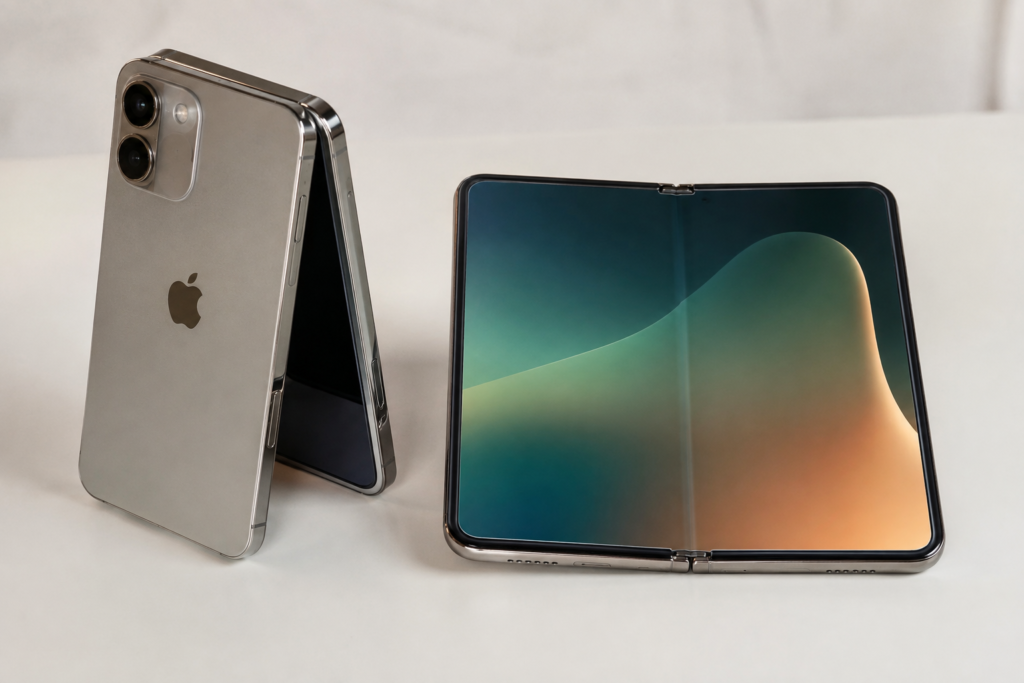
Apple’s foldable is expected to follow the now-familiar “book-style” folding phone format, similar to Samsung’s Galaxy Z Fold — a large inner display for tablet-like multitasking, and a smaller cover screen for quick, phone-like use.
The foldable’s form factor appears to be firming up around a roughly 5.3–5.5-inch outer screen that opens to a roughly 7.8-inch inner display, with previously reported hinge problems said to be largely resolved — though a genuinely crease-free display remains uncertain. Display supplier details have also emerged: the inner OLED foldable panel is reportedly built by Samsung Display at 7.76 to 7.8 inches, with a 1920 x 2713 pixel resolution, 120Hz ProMotion, 428 PPI, HDR10+, Dolby Vision, and up to 2,000 nits of peak brightness, while the outer cover display comes in at roughly 5.5 inches with a 1422 x 2088 pixel resolution.
Beyond the screens, Apple is reportedly chasing a design that feels genuinely premium rather than experimental. Apple is said to be prioritizing an ultra-thin design, potentially measuring around 4.5mm thick when unfolded, paired with a titanium-based frame for durability without adding bulk. The hinge is getting special attention too, with an advanced hinge mechanism reportedly in development to minimize the visible crease on the inner display — a persistent complaint with existing foldables from other manufacturers.
One notable departure from recent iPhone design language: biometrics. Several reports indicate Apple may skip Face ID here in favor of a side-mounted or power-button Touch ID sensor, likely due to space constraints inside the ultra-thin folding chassis — a genuinely unusual move for a modern flagship iPhone.
iPhone 18 Fold Specs: Chip, RAM, and Battery
At the heart of the device sits Apple’s next-generation silicon. According to GF Securities analyst Jeff Pu, the iPhone Fold will be powered by the A20 Pro chipset and will also include Apple’s N2 chip. That chip is built on a cutting-edge node, and reporting suggests some genuinely novel packaging tech is involved. The Fold’s A20 Pro, built on TSMC’s 2nm process and shared with the iPhone 18 Pro, is said to use new WMCM packaging that stacks 12GB of RAM directly onto the chip wafer — a meaningful jump from the 8GB configuration found in the iPhone 17 lineup.
That RAM boost isn’t unique to the foldable, either. Some reports suggest Apple could standardize 12GB of RAM across its entire 2026 iPhone lineup, which would make multitasking on the Fold’s larger inner display noticeably smoother than on any previous iPhone.
Battery life has also been a major focus, understandably so given how much power a dual-screen foldable can draw. The iPhone Fold is rumored to pack a high-density battery between 5,400mAh and 5,800mAh — the largest ever fitted into an iPhone — with a vapor chamber cooling system reportedly included to keep performance stable during demanding tasks. For comparison, even the standard Pro Max line is expected to top out lower: the iPhone 18 Pro Max is rumored to carry a battery north of 5,000mAh, potentially as high as 5,200mAh in some claims.
Cameras: A Simpler System Than the Pro Line
Given the engineering challenge of fitting camera hardware into an ultra-thin folding body, Apple appears to be trimming back on optics compared to the Pro Max. The foldable is expected to feature two rear cameras and skip a telephoto lens entirely. That’s a notable step down from the triple-camera systems found on recent Pro models, though it’s consistent with how most foldable phones on the market handle their camera compromises in service of a thinner hinge and chassis.
Other reporting paints a slightly different picture, suggesting Apple might not compromise as much as expected. One recent leak claims a 48MP triple rear camera array paired with a 24MP dual front camera setup, keeping the Fold’s optics roughly on par with the iPhone 18 Pro rather than cutting corners to save space. Given these conflicting reports, the safest takeaway is that Apple is still finalizing the exact camera configuration, and buyers should expect anywhere from a dual-camera setup to a scaled-down triple system.
On the front-facing side, there’s more agreement across the wider iPhone 18 lineup. A 24MP front camera, up from 18MP, is expected to span the entire 2026 lineup for sharper selfies and video calls.
How Does It Compare to the iPhone 18 Pro and Pro Max?
While the foldable steals headlines, it’s launching alongside two more traditional flagships that are getting their own meaningful upgrades.
All three premium devices — the iPhone 18 Pro, iPhone 18 Pro Max, and the foldable — are expected to share a next-generation 2nm A20 chip, reportedly up to 15% faster and 30% more efficient than the A19, paired with Apple’s new C2 modem. Pricing on the standard Pro line is also expected to inch upward: the iPhone 18 Pro could start around $1,299 and the Pro Max around $1,399, roughly a $100–$200 increase over the iPhone 17 Pro lineup.
On the camera side, the Pro Max is tipped to get hardware the Fold likely won’t have. The iPhone 18 Pro Max is expected to gain a variable aperture main camera — a mechanism that physically adjusts how much light reaches the sensor, giving users real control over depth of field and improved low-light performance — along with additional sensor refinements across the Pro camera system. There’s also a fresh color option generating buzz: leaks point to a deep, wine-red “Dark Cherry” finish reportedly replacing last year’s Cosmic Orange on the Pro Max.
For everyday iPhone 18 and iPhone 18e buyers, don’t expect much drama. The standard iPhone 18 models aren’t expected to see design changes, continuing with the same 6.3-inch display for the iPhone 18 and 6.1-inch size for the iPhone 18e. Interestingly, Apple appears to be narrowing the gap between its cheapest and mid-tier phones: the iPhone 18 and iPhone 18e are expected to share components, with certain parts reportedly interchangeable between the two models.
Should You Wait for the iPhone 18 Fold?
For most people, the honest answer is probably not. A rumored $2,000-plus starting price, limited first-year supply of only 7–8 million units globally, a trimmed-down camera system in some leaks, and the inherent trade-offs of first-generation foldable hardware make this a device aimed squarely at early adopters and Apple loyalists rather than the mainstream iPhone buyer. For most buyers who don’t need bleeding-edge specs, picking up an iPhone 17 after the September event may actually be the smarter move financially.
That said, there’s genuine excitement here for a reason: this is Apple’s first real entry into a device category that Samsung, Google, and Xiaomi have already spent years refining. A thinner design, a smaller crease, a strong hinge, smooth software, and the familiar iOS experience could help the phone stand out — even in a market where Apple isn’t first, just very, very polished.
iPhone 18 Fold: Quick Specs Summary
- Release date: Rumored September 9, 2026, alongside the iPhone 18 Pro and Pro Max (possible slip to October for retail availability)
- Price: Starting around $1,999–$2,000; higher configurations could exceed $2,500
- Display: ~7.8-inch inner OLED (120Hz ProMotion, up to 2,000 nits) + ~5.5-inch outer OLED cover screen
- Chip: A20 Pro (TSMC 2nm process) with Apple’s N2 chip
- RAM: 12GB (up from 8GB in the iPhone 17 series)
- Battery: Estimated 5,400mAh–5,800mAh, the largest in any iPhone to date
- Cameras: Reports vary — dual rear camera (no telephoto) in some leaks, 48MP triple rear array in others
- Biometrics: Touch ID rumored in place of Face ID
- Storage: 256GB to 1TB, no microSD support
- Build: Titanium frame, ~4.5mm thin when unfolded
Final Thoughts
The iPhone 18 Fold represents Apple’s biggest design gamble in years — a premium, book-style folding iPhone with a massive inner display, Apple’s most advanced chip yet, and a price tag to match its ambitions. While official confirmation is still pending, the volume and consistency of leaks from credible analysts like Ming-Chi Kuo and JPMorgan’s Samik Chatterjee suggest this device is very real and very close to launch. Whether it becomes a genuine hit or a niche halo product for die-hard Apple fans will depend heavily on how well Apple executes on the crease, the hinge durability, and — as always — the price. Stay tuned as we get closer to Apple’s expected September 2026 event, where the iPhone 18 Pro, iPhone 18 Pro Max, and the long-awaited foldable iPhone are all expected to take the stage together.
This article is based on current rumors, leaks, and analyst reports. Apple has not confirmed any details about the foldable iPhone, including its name, price, specifications, or release date. All information is subject to change.